
China’s Automotive AI Chip Race Risks “Redundant Investment” and Cutthroat Competition
China’s booming push to build in-house AI chips for electric vehicles’ autonomous driving is starting to look like a capacity bubble, according to a prominent industry figure who warned that the market is already awash with too many chip variants chasing too few car deliveries.
Speaking at a vehicle launch event, Zhu Jiangming, founder and chairman of Leapmotor—long viewed as one of China’s early pioneers in automotive AI silicon—said the sector has entered a phase of “oversupply.” Zhu argued that 14 AI-chip products have already been introduced into a market whose annual demand is only about 10 to 20 million vehicles. He traced the problem to redundant investment by multiple automakers and tech-linked players who are developing overlapping solutions without achieving the shipment volumes needed to spread research and manufacturing costs.
Zhu’s comments drew attention not only because of the oversupply warning, but also because of his track record. Before founding Leapmotor, Zhu co-founded Dahua Technology and has been involved in semiconductor development since the early 2000s. At Leapmotor, he helped drive the launch of “Lingxin 01,” described as China’s first AI autonomous-driving chip based on independent intellectual property, which entered mass production in 2020. Yet Zhu says the company has recently shifted course, choosing to use externally sourced chips—such as those from Qualcomm—in its newer models rather than continuing to expand its own silicon portfolio.
His rationale is blunt: without reaching scale comparable to global manufacturing giants, chip self-development may not be cost-effective. He said the industry should focus on innovating core components and finished vehicles until shipment volumes are large enough to justify the economics of internal semiconductor production.
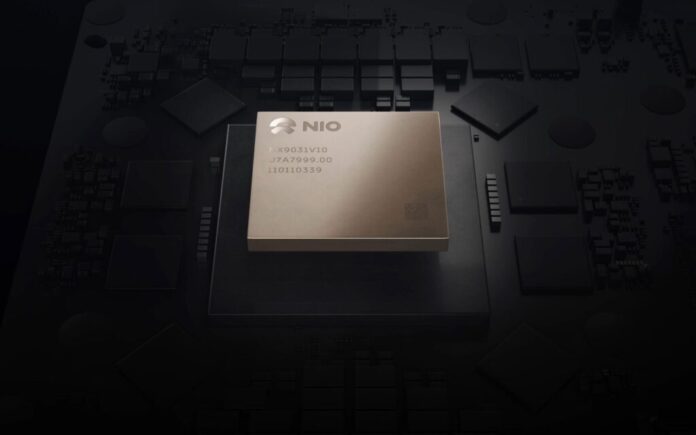
Despite Zhu’s caution, China’s largest EV players are still accelerating their own chip efforts. Nio is producing its 5-nanometer-class autonomous-driving chip, “Shenji NX9031,” and has even indicated external sales could be considered. Xpeng unveiled mass production of its self-developed “Turing” AI chip in April, framing it as a foundation for a broader “physical AI” roadmap that includes robotaxis and robotics. BYD recently introduced its 4-nanometer-class autonomous-driving chip, “Xuanji A3,” and Li Auto has fitted its “M100” chip into a flagship SUV, marking its first such integration this year.
The strategic push is understandable. As the competitive center of gravity shifts from battery and pricing toward “software-defined vehicles,” automakers are seeking control over compute performance, power efficiency, and the tight pairing between hardware and proprietary autonomous-driving algorithms. In addition, supply-chain fragility is a growing concern: if advanced chips from major suppliers become subject to tighter export restrictions or sanctions, vehicle companies that rely heavily on external components could face disruptions.
Nio’s leadership has previously argued that self-developed chips can reduce costs by consolidating multiple high-end chips into a single design. But even with these incentives, analysts warn that the economics may be difficult to sustain. Nvidia and other established players still dominate significant portions of the market for high-performance chips used in urban autonomous driving, and China’s broader supply-chain capabilities—spanning wafer manufacturing, advanced packaging, testing, and vehicle-level integration—remain uneven.
The industry is also dealing with a separate, well-documented profitability squeeze. China’s EV market has been locked in “neijuan,” a term describing intensely competitive, sometimes self-destructive rivalry. Industry capacity is said to exceed demand, while price cuts are eroding margins across the sector. A common argument is that if multiple firms keep escalating spending on next-generation tech without a realistic path to sustainable profits, the result could be a winner-takes-most outcome—potentially benefiting global scale leaders more than struggling challengers.
Researchers and semiconductor executives add that the barrier is not only technological but financial. One estimate cited is that developing a single large automotive system-on-chip can require around 1 billion yuan (about $148 million), and that profitability may require tens of millions of units shipped. With annual demand unlikely to match the number of chip variants flooding into production, Zhu’s oversupply warning suggests China’s automakers may soon confront the harsh reality that innovation racing and unit economics do not always align.

