
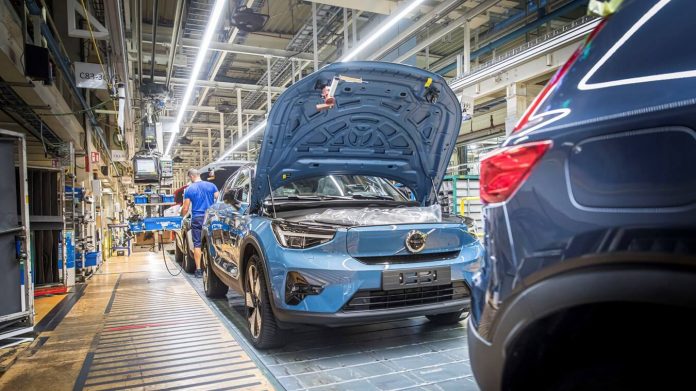
Europe’s flagship auto plants are being repurposed as contract-manufacturing hubs for Chinese electric-vehicle (EV) brands, a development industry analysts say signals a structural shift in the global car industry from “Western technology, Eastern markets” to “Eastern technology, Western production.”
Industry sources confirm Nissan has signed a memorandum of understanding with Chery Automobile to produce Chery models at its Sunderland plant in the UK — the first large-scale manufacture of a Chinese brand in Britain. Under the arrangement Nissan would retain plant ownership and workforce management while Chery commissions production above agreed volumes and pays fees; the companies are also exploring production of Chery’s Omoda 5 at Nissan’s idled Barcelona facility in Spain. Nissan last month consolidated two Sunderland lines into one and suspended some operations, a reflection of the underuse affecting many European sites.
Stellantis has also agreed to build Chinese-branded models under contract, planning production of Leapmotor’s B10 electric SUV at its Zaragoza plant in Spain and discussing similar manufacturing for premium Chinese marque Hongqi. Volkswagen is in talks with Xpeng on possible plant deals and contract production. Executives and analysts say these partnerships answer a mutual need: European OEMs have surplus capacity and worsening profitability after costly EV transitions, while Chinese makers want local production to avoid high EU import duties and improve market access.
Utilization at European plants has fallen to worrying levels. Consultancy research shows average European plant utilization around 55%, with Nissan’s Sunderland reportedly operating at roughly 45.5% capacity in 2025 — about 273,000 units versus designed capacity far higher. AlixPartners estimates idle capacity across Europe exceeds two million vehicles, well above the industry health benchmark of 70–90% utilization. The overcapacity has coincided with a string of restructuring moves, including plant closures, production cuts and layoffs across major groups.
The financial toll is visible in recent results. Nissan recorded global sales of 3.15 million units in fiscal 2025 and consolidated revenue of ¥12 trillion ($75 billion), but operating profit dropped 16.9% and net losses for the company reached ¥533.1 billion ($3.3 billion) that year; combined with the prior year’s ¥670.9 billion loss, cumulative net losses over two years exceed ¥1.2 trillion (~$7.5 billion). Volkswagen’s holding company Porsche SE was recently removed from Germany’s DAX index after its market value fell to roughly a third of 2021 levels, underscoring investor concern over the sector’s transition.
Meanwhile, Chinese exporters are expanding rapidly. Data from Chinese industry bodies show auto exports surging: May shipments hit about 930,000 units, up nearly 69% year-on-year, and cumulative January–May exports rose roughly 63%. New energy vehicles accounted for over 45% of shipments. Chery, the country’s top exporter, reported May exports of 182,000 units and year-to-date exports of 749,000 units; its European sales reportedly rose more than 200% in 2025 and climbed 170% year-on-year in Q1 2026 to about 90,600 units. In the UK, combined sales of Chery and its sub-brands placed them second only to Volkswagen in April, and well ahead of Nissan.
Tariffs and logistics considerations are a primary driver of localization. The European Union imposed countervailing duties and minimum-price measures on some Chinese EVs in 2024 and 2025, heightening the cost of exports. Local production allows Chinese automakers to sidestep steep duties — which can reach into the mid-30% range on top of base tariffs — while reducing long supply chains and inventory drag from maritime transport.
Chinese industry figures cast the shift as pragmatic. “Leveraging Europe’s existing production capacity to pursue localization is an excellent development approach,” said an industry association executive, arguing contract manufacturing preserves jobs at local plants, speeds market entry, and exerts competitive pressure on Europe’s industrial ecosystem to modernize.
The move builds on a broader overseas push: Chinese automakers have acquired or established production bases in Thailand, Brazil and Indonesia in recent years. An AlixPartners study cited by industry watchers projects Chinese overseas production rising from about 1.2 million units in 2025 to 3.4 million by 2030, spanning at least 16 countries.
For Europe, the immediate benefit is higher utilization and preservation of local jobs. For legacy automakers, however, the trend marks a tough strategic choice: monetize idle plants by producing competitors’ vehicles or risk prolonged losses while attempting to rebuild demand for their own EVs. For Chinese manufacturers, establishing “Western” production footprints offers a lower-tariff pathway to scale in a key market, accelerating a reconfiguration of the global automotive production map.

