
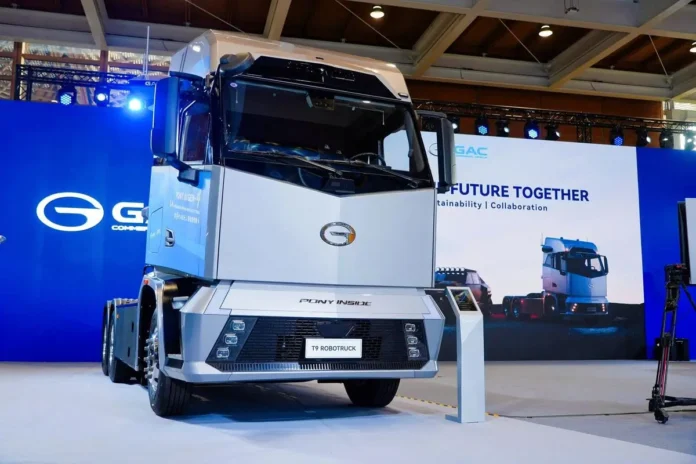
Chinese autonomous-driving companies are shifting their focus to commercial vehicles, marking a significant industry pivot as competition in the passenger-car smart-driving market tightens. A wave of launches in late October demonstrates the trend’s momentum, with multiple suppliers announcing heavy-truck programs and partnerships with major vehicle manufacturers.
Zhuoyu Technology introduced its commercial-vehicle technology brand “Zhuoyu Panxing” on October 29, unveiling partnerships with seven commercial-vehicle makers including XCMG Automotive, Shaanxi Automobile Group, Sinotruk and Foton Motor. On the same day, Pony.ai and GAC Lingcheng rolled out mass-produced units of the T9, an autonomous heavy truck rated at Level 4 autonomy. Other suppliers including QCraft, Minieye and Desay SV have also entered unmanned logistics operations, signaling a broader industry repositioning.
The shift reflects intensifying pressures in the passenger-car segment. While the advanced-driver-assistance market continues expanding into lower price categories and urban navigation features move into more mainstream vehicles, suppliers face eroding profit margins. Automakers increasingly are developing their own autonomous-driving systems, some pursuing full in-house development while others combine internal work with supplier partnerships. Competition has moved beyond feature comparisons to encompass cost, mass production and integration efficiency, leaving suppliers struggling to command premium valuations.
By contrast, the technical value of commercial-vehicle autonomous driving translates more directly into measurable operating savings. Zhuoyu’s newly launched PDS 4 system for heavy-truck highway routes demonstrates this advantage. According to the company, its fuel-saving algorithm achieved measured savings of 4.5 to 7.5 percent in real-world testing across 230 vehicles and more than 20 million kilometers of operation—equivalent to approximately $3,000 to $4,500 annually per truck. Several hundred vehicles equipped with the system are now operating in express trunk-line service following mass production that began in June 2026.
The different business models also reflect varied strategic priorities among suppliers. Zhuoyu is extending capabilities built in passenger cars to commercial vehicles by combining existing data and algorithms with heavy-truck-specific adaptation. The company draws on more than 3 billion kilometers of passenger-car driving data and 400 million frames of heavy-truck-specific footage to train models suited to commercial operations.
Pony.ai is pursuing a more ambitious autonomous-freight approach, moving beyond driver-assistance functions to full vehicle autonomy under defined conditions. This path requires solving operational challenges beyond vehicle control, including fleet dispatch, remote assistance, exception handling and transport networks. The company disclosed that a key constraint on expansion speed has been the high cost of Level 4 autonomous systems, though its latest hardware generation has cut costs by approximately 70 percent compared to previous versions.
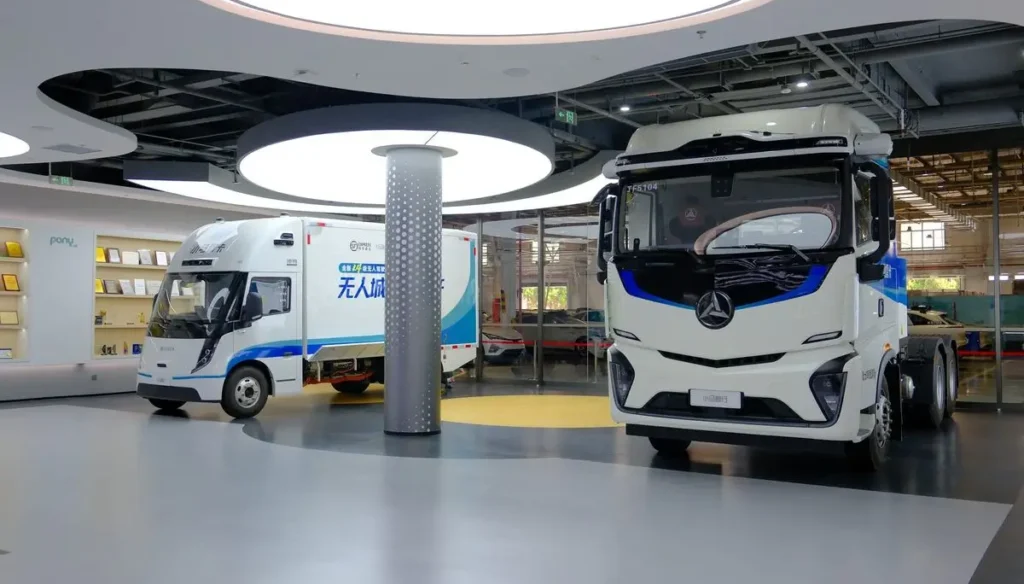
Smaller suppliers are targeting different segments. QCraft is developing unmanned-logistics vehicles for urban delivery networks, while Minieye is supplying autonomous-delivery vehicles to logistics partner Didi Delivery following a July 2026 agreement. Desay SV launched a low-speed unmanned vehicle brand targeting campus delivery and other confined scenarios.
Yet expanding across vehicle categories presents substantial technical obstacles that experience from passenger cars does not easily overcome. Heavy trucks vary sharply in weight between loaded and empty states, affecting braking distance and vehicle dynamics. They require larger turning radius, different steering characteristics and separate braking-system calibration. Zhuoyu executives report that adapting passenger-car models to commercial vehicles required two to three months for feasibility assessment, while bringing the first commercial project to mass production took more than a year, predominantly spent on safety validation.
Despite these challenges, suppliers recognize shared underlying hardware and software components can reduce development costs for commercial-vehicle solutions. By training on mixed passenger and commercial vehicle data and adjusting model structure accordingly, companies can lower the expense of heavy-truck-specific systems compared to developing entirely new platforms.
Industry observers expect the competitive intensity to increase. Zhuoyu’s CEO noted that proven market potential will attract additional entrants, potentially including competitors from the passenger-car segment itself. As autonomous-driving companies diversify beyond passenger vehicles into commercial freight, trucks and unmanned delivery, the industry’s definition of success appears to be shifting from racing to deploy single features to building sustainable business value across multiple mobility scenarios.

