
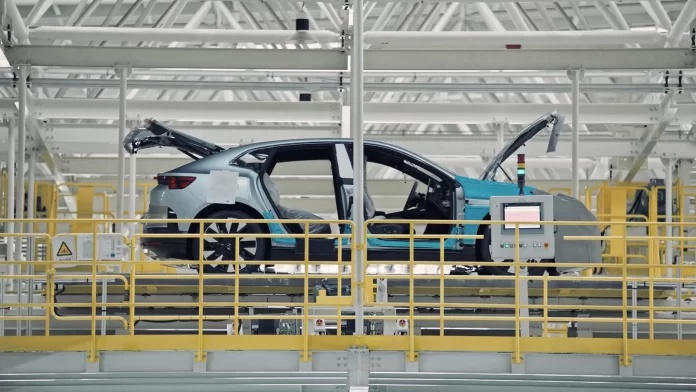
Chinese carmakers are moving beyond exporting vehicles and toward building factories, service networks and research operations abroad, industry leaders said at a Beijing forum this month. Speakers at the Second Transportation and Connected Vehicles Summit, held November 3 as part of the 2026 World Internet of Things Convention, agreed that new energy vehicles and intelligent connected technology give Chinese brands a strong product base overseas. They also said that sustaining growth after the first sales wave will require stable local operations and a way to turn technological strengths into lasting brand value.
Export Growth Accelerates
Export data shows the scale of the shift. According to the China Association of Automobile Manufacturers, China exported 7.098 million vehicles in 2025, up 21.1 percent from the previous year. Exports of new energy vehicles reached 2.615 million units that year, a rise of 103.7 percent. In the first three quarters of 2026, new energy vehicle exports climbed to 4.006 million units, up 127.9 percent, increasing their share of total vehicle exports.
| Period | Total Vehicle Exports | Year-on-Year Growth | New Energy Vehicle Exports | Year-on-Year Growth |
|---|---|---|---|---|
| Full Year 2025 | 7.098 million units | 21.1% | 2.615 million units | 103.7% |
| First Three Quarters of 2026 | Not disclosed | Not disclosed | 4.006 million units | 127.9% |
Local Conditions Shape Product Design
Demand differs widely between markets, making it hard to transfer domestic models directly. European cities have narrow streets and steady demand for small, compact cars. The Middle East’s hot, dusty climate places a premium on reliability and air-conditioning performance. Some Latin American countries use ethanol-blended gasoline, which requires fuel system components suited to that fuel. Regulations, trade rules and after-sales requirements also vary, so manufacturers must adapt models, configurations and sales methods for each market.
Trade Barriers Add Pressure
Policy risks are growing. The European Union has imposed countervailing duties on battery electric vehicles made in China since 2024, with the highest rate reaching 35.3 percent. In January 2026, the EU issued guidance on price undertakings, which gives Chinese automakers a framework to apply for alternatives to tariffs, though export prices and profit margins remain under pressure. In the United States, the Alliance for Automotive Innovation on November 2 urged Congress to pass a bill that would permanently bar Chinese vehicles from the market. The bill has cleared a relevant Senate committee, and if it becomes law, Chinese cars would face tighter restrictions.
Expanding Production Abroad
Several companies are building overseas production capacity. Su Tao, vice chairman of the World Internet of Things Convention’s executive committee, said the industry is entering a stage of ecosystem-level expansion and deeper localization. Chery has production operations in Brazil, Egypt, Central Asia and Malaysia. BYD is building plants in Thailand and Brazil and is moving its Hungary plant into mass production. Geely is producing locally in Egypt and Indonesia and strengthening local sales and service networks.
The UK as a Test Case
The United Kingdom offers an early indication of how Chinese brands are performing in a developed market. David Wong, head of technology and innovation at the Society of Motor Manufacturers and Traders, said at the World Intelligent Connected Vehicles Conference on October 22 that Chinese brands held 17.5 percent of UK new car registrations from January to September 2026. Their share of the battery electric segment reached one-third. In September alone, Chinese brands registered 81,776 vehicles, or 23.3 percent of the month’s total. BYD‘s September registrations rose 78.7 percent to 20,140 units, placing it second only to Volkswagen among all brands.
Wong attributed much of this success to pricing. Chinese new energy models, mostly battery electric and plug-in hybrids, typically include advanced features as standard, so buyers do not pay extra for options. Consumers’ main concerns, he said, are whether parts supply and repair networks are reliable, and whether vehicle data is secure. Most major Chinese brands have committed to storing data collected by their vehicles within the European Union.
Trade policy remains a major uncertainty. The UK’s trade secretary told a media outlet on October 15 that the government is discussing with European partners the possibility of tariffs on Chinese electric vehicles, and advocated coordinated action between the UK and EU.
Digital Testing Reduces Development Costs
Greater vehicle intelligence is also making research and validation more complex. Wang Zhifu, party secretary of the National Engineering Research Center for Electric Vehicles at the Beijing Institute of Technology, spoke at the forum on digital testing for intelligent new energy vehicles. As the number of test scenarios grows, companies are looking to digital tools to cut costs and shorten timelines.
Intelligent driving systems illustrate the challenge. Road signs, traffic signals, driving habits and weather differ from country to country, and each affects how a system recognizes its surroundings and makes decisions. Digital simulation allows engineers to recreate different traffic conditions and identify problems before a vehicle reaches a new market.
Zhou Yue, an automotive industry analyst, said entering several markets at once increases R&D spending and can lengthen development cycles. Digital testing, he said, lets companies simulate road conditions in multiple markets during the design stage, reducing repetitive physical testing. Testing speed will also affect when new models can launch overseas.
Data rules and software support add further demands. Countries set different requirements for collecting, storing and transferring vehicle data across borders. Connected and intelligent features also need ongoing software updates and after-sales technical support after delivery. These needs are creating opportunities for suppliers of testing equipment, simulation software and connected vehicle technology.
Chinese automakers’ overseas strategy has moved from exporting cars to producing them locally and adapting research and testing for foreign markets. Whether rising export volumes turn into lasting overseas operations will depend on how quickly companies invest in regulatory compliance, service networks and research efficiency.

