
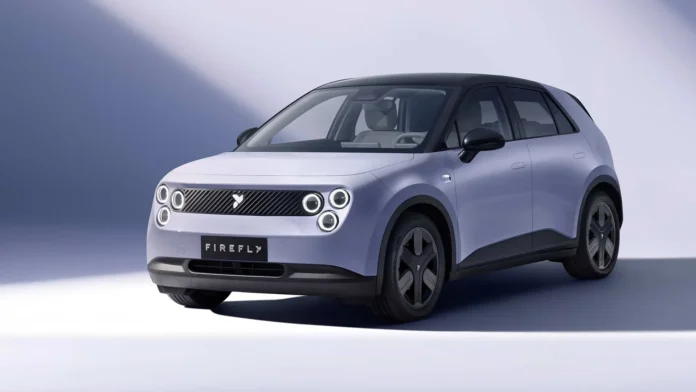
While China’s automotive market contracts sharply in 2026, a small but resilient segment of entry-level sedans has defied the downturn, growing 18% year-on-year through September. Yet within this bright spot lies a puzzle: only one premium electric hatchback—NIO’s Firefly—has achieved meaningful success, while virtually all other competitors have struggled or failed.
A Growing Market, But a Narrow Price Band
The A0-segment sedan market retailed 829,000 units in the first nine months of 2026, capturing 6.2% of overall sales and standing among the few expanding categories as overall volumes retreat to decade-low levels. However, fewer than a dozen models manage to sell more than 5,000 units monthly, suggesting concentration among established players.
The most striking feature is the price structure. Most competitors—including Geely, BYD, Wuling, Chery, Leapmotor, and MG—cluster between 60,000 and 90,000 yuan (roughly $9,000–$14,000). Firefly stands as a dramatic outlier at 120,000–150,000 yuan ($18,000–$23,000), commanding a premium of 50,000–60,000 yuan over comparable rivals.
Other Premium Hatchbacks Falter
The broader premium electric hatchback category reveals systemic weakness. The Smart #1, viewed as a category standard-bearer, sold just over 2,400 units in September—its best performance in recent months following a price cut and refresh. MINI’s EV models sell under 1,000 monthly units combined. The Audi Q2L e-tron has been discontinued, the Volvo EX30 sells in double-digit quantities, and even Zeekr X, positioned as premium-oriented, has never ranked prominently. The competitive scorecard is stark: on this track, Firefly alone is winning.
Why Automakers Avoid Premium Small Cars
Manufacturers’ reluctance to pursue this segment reflects straightforward economics. Large vehicles priced at 150,000 to 500,000 yuan command healthy profit margins and attract intense competition. Small cars, despite their size, demand identical component validation and engineering as their larger counterparts, saving costs only in materials. The result: a hatchback selling 10,000 units monthly generates roughly the same revenue as selling 2,000 large vehicles priced above 300,000 yuan.
Small cars typically require break-even volumes around 20,000 units monthly, putting them within reach only of scale giants like BYD, Geely, Wuling, and Leapmotor. Luxury brands including Mercedes-Benz, BMW, and Audi are systematically exiting this segment, finding that sacrificing significant unit sales erodes brand value more than the numbers justify.
Consumer Resistance to Premium Pricing
From the buyer’s perspective, the calculus is equally unfavorable. A budget of 150,000 yuan secures a mid-size SUV equipped with advanced safety features and genuine family capacity. Asking consumers to spend 120,000–130,000 yuan on a small car that seats only one or two people daily triggers predictable skepticism. A market consensus has hardened: small electric vehicles belong in the 50,000–100,000 yuan range. When brands deviate upward by 50,000–60,000 yuan, consumers question why identical motors and batteries command such premiums.
Firefly’s Exceptional Formula
Firefly succeeds through a combination of factors extending beyond the vehicle itself. NIO’s years of brand investment, battery-swap infrastructure, and its battery-as-a-service (BaaS) rental model collectively enable the pricing anomaly. While the official price reaches 150,000 yuan, buyers selecting BaaS reduce the effective entry point to 80,000–90,000 yuan, matching conventional competitors.
Critically, Firefly and budget-conscious competitors attract fundamentally different buyers. Budget buyers prioritize affordability and space; Firefly buyers value quality, safety, individuality, and the NIO brand. The BaaS model offers psychological relief—buyers avoid fretting over battery degradation and residual value, with planned replacements every three to five years at roughly 300 yuan monthly. Superior crash test performance reinforces the premium proposition.
Market-Wide Correction
Recent competitor actions confirm the constraints. Lynk & Co’s newly launched model reversed its predecessor’s high-price strategy, introducing 800V architecture, standard lidar, and price reductions of 12,000 yuan despite hardware upgrades. Smart’s price cuts from 170,000–200,000 yuan to 140,000–150,000 yuan rebounded sales but remain subdued as Mercedes-Benz and BMW’s brand dividends in China have diminished substantially.
Industry Implications
Industry analysis suggests two conclusions: the A0 segment’s growth dividend flows primarily to top-tier Chinese independents, while second-tier brands and new entrants face profitability challenges. Second, premium hatchbacks are losing pricing power systematically, even for automotive giants. Firefly’s success remains an outlier dependent on its parent’s distinctive infrastructure and will prove difficult to replicate, meaning premium hatchbacks will remain a niche segment rather than a scaled opportunity for most competitors.

