
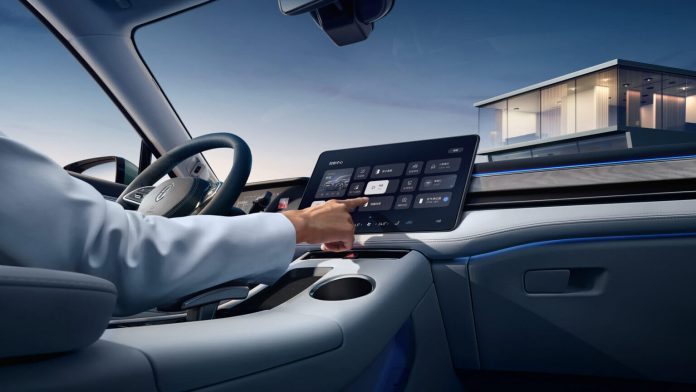
China’s automotive competition in 2026 has decisively shifted from batteries and body styles to in‑vehicle artificial intelligence, with independent EV challengers and legacy manufacturers racing to ship “cognitive cockpits,” while foreign automakers double down on China partnerships even as they slow global electrification plans.
New‑era EV makers leading the charge
Li Auto, NIO and XPeng have recast themselves as AI companies rather than traditional carmakers. Li Auto founder Li Xiang has framed 2026 as a last call to become an AI leader, predicting Level 4 autonomy by 2028 and asserting that only “no more than three” companies worldwide can realistically develop foundation models, chips, operating systems and embodied intelligence at scale — a grouping Li Auto aims to join. NIO has laid out a three‑stage cockpit evolution from functional to “cognitive” cockpits, and XPeng now positions itself as an “embodied intelligence” firm expanding beyond mobility into broader physical‑AI applications.
These newcomers are investing heavily across on‑device large models, high‑performance in‑vehicle computing, proprietary AI chips and integrated software stacks. Their vehicles now lead in reported in‑car compute configurations, a metric increasingly treated as a proxy for competitive advantage in cockpit intelligence and assisted driving.
Traditional automakers pursue cross‑domain “full‑vehicle intelligence”
Established Chinese groups are responding pragmatically. BYD’s “Xuanji” full‑vehicle architecture aims to democratize intelligent features at scale; Geely is building a centralized “universal vehicle brain” with multimodal memory and model‑deployment frameworks; GAC, Great Wall and Changan are rolling out multi‑agent and agent‑driven control and scheduling solutions to fuse cockpit, driving, powertrain and chassis domains. The strategy among incumbents emphasizes manufacturing scale, cost optimization and cross‑domain integration to translate AI into tangible user value.
Global players: retreat abroad, accelerate in China
Many international automakers have adopted a dual‑track approach: temper global EV and high‑level autonomy rollouts while accelerating China‑focused AI collaborations. BMW, Mercedes‑Benz and Volkswagen have publicly deprioritized some Level‑3 and full electrification plans in overseas markets but are expanding China partnerships with local suppliers. Momenta has emerged as a go‑to partner for autonomous‑driving systems; Huawei’s HarmonyOS cockpit is rapidly being adopted across marques and even on some internal‑combustion models. Volkswagen’s China models are being replatformed with local AI chips and architectures developed with XPeng, and Mercedes and BMW are embedding China‑centric AI assistants and driving systems developed with local partners.
Tesla remains a notable outlier, continuing an integrated “wheeled‑robot” approach that aligns more closely with the Chinese new‑EV cohort than with traditional foreign OEMs.
Computing power, on‑device models and commercialization challenges
The race has crystallized around three technical battlegrounds: in‑vehicle computing power, deployment of on‑device large models with cloud synergy, and AI operating systems that enable multi‑agent, cockpit‑driving integration. Automakers’ advertised TOPS and dual‑chip configurations have become promotional and strategic focal points, but significant hurdles remain: reliable on‑device model performance, safety and verification for higher autonomy, power and thermal constraints, and viable business models for features that require cloud connectivity or heavy local compute.
Market realities and strategic recalibration
The broader industry context is influencing choices. Global EV demand softness, rising development costs and recent losses at some legacy firms (notably Honda’s reported 2025 loss and revised electrification targets) have nudged OEMs toward hybrid strategies—mixing gasoline, hybrid and selective EV offerings—while localizing supply chains through Chinese partners. The result is intensified localization of smart‑driving and cockpit stacks in China even as global electrification timelines get pushed back.
Outlook
China’s 2026 auto market will be defined less by who sells the most EVs and more by who controls the in‑vehicle AI stack — foundation models, chips, operating systems and agent frameworks. New EV players currently enjoy an edge in integrated AI deployments, incumbents are leveraging scale to operationalize full‑vehicle intelligence, and foreign OEMs are choosing collaboration over confrontation in China. The next 12–24 months will test whether on‑device AI and cognitive cockpits can translate into differentiated products, safe higher‑level autonomy and sustainable monetization.

