
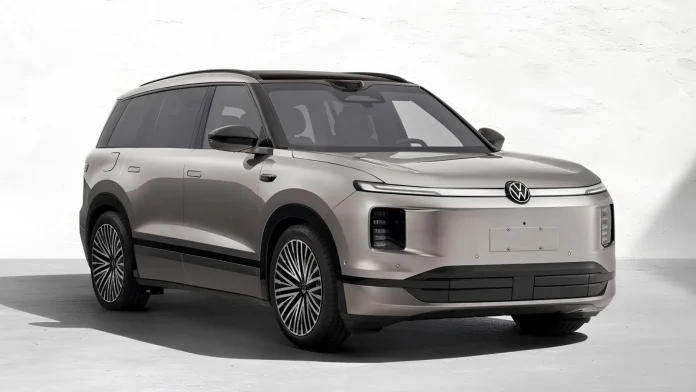
German automaker plans to deploy China-developed platforms in South America and Africa as it battles domestic competition
Volkswagen announced on October 28 that it will leverage technology developed in China to expand into emerging markets across South America and Africa, marking a strategic shift from serving only Chinese consumers to using the country as a global innovation hub.
The centerpiece of this reorientation is the “Compact Main Platform,” built on the “China Electronic Architecture” (CEA)—an electronic control system co-developed with Chinese technology companies at VW‘s research and development base in Hefei. The company plans to begin deploying these platforms in South America by the late 2020s and aims to increase exports of China-manufactured VW and Jetta-brand vehicles to the Global South over coming years.
The move signals a fundamental recalibration of VW’s China strategy, rebranded as “In China, Beyond China”—departing sharply from the previous “In China, For China” localization approach that confined Chinese development to domestic markets.
“China is a key driver of innovation for the VW Group and is increasingly important as a base for products and technologies for global markets,” VW Group CEO Oliver Blume said in a statement. The strategy targets Southeast Asia, Latin America, and Africa, while notably excluding Europe and North America for the time being.
Technology Advantages and Development Efficiency
VW highlighted the commercial appeal of its China-developed architecture. According to the company, localized development in China can reduce development timelines by up to 30%—a significant advantage as automakers race to roll out affordable electric vehicles globally.
The company unveiled the “VEGA” technology package, designed to support 850-volt fast charging and prepared for Level 3 autonomous driving capabilities, scheduled for introduction in 2027. The CEA, co-developed with Chinese partner XPeng, enables vehicles to control and update functions via software across multiple platforms and drivetrain types—a capability increasingly critical in the competitive EV market.
Pressure Mounting in China’s Market
The strategic pivot reflects intensifying pressure in China, where VW’s market share is eroding rapidly. Domestic players such as BYD and Geely Auto are outperforming foreign rivals in electric vehicles, software capabilities, and price competition.
Ralf Brandstätter, head of VW’s China operations, expects the Chinese passenger car market to shrink by approximately 20%—roughly 4.5 million units—in 2026. In response, VW is pursuing the largest business restructuring in its 89-year history, aiming to transform China from a historic profit engine into a cost-efficient development and export hub.
Despite these efforts, VW acknowledges that reviving Chinese sales and converting technology partnerships with local innovators into commercial success remain significant challenges. The company is banking on a fresh wave of new model launches to “regain the initiative” in its largest market.
Trend Among Global Automakers
VW’s approach mirrors strategies adopted by other established automakers facing similar headwinds. General Motors, Hyundai Motor Company, and Renault are accelerating comparable initiatives, leveraging Chinese development capabilities to compete with homegrown EV manufacturers in international markets.
The dynamic reflects broader competitive pressures. Chinese automakers, confronted with intensifying domestic competition and excess production capacity, are pursuing exports more aggressively. Competition in emerging markets is expected to intensify sharply as these players expand globally.
There is speculation within the industry that VW may eventually deploy the CEA developed with XPeng to European mass-market vehicles as well, a move that could reshape VW’s software development partnership with U.S. EV maker Rivian Automotive, a collaboration valued at $5.8 billion. VW declined to comment on such possibilities.
Political and Commercial Calculation
VW’s deliberate exclusion of Europe and North America appears strategically cautious, likely reflecting political sensitivities around Chinese technology and awareness of escalating tariff barriers against Chinese-origin products.
The success of VW’s restructuring hinges on balancing two competing objectives: rebuilding its struggling China business while simultaneously repurposing Chinese development advantages for global expansion. If other established automakers follow suit and increasingly export China-developed technology to emerging markets, price competition will intensify further—potentially pressuring the profitability of Western automakers in these high-growth regions.

