
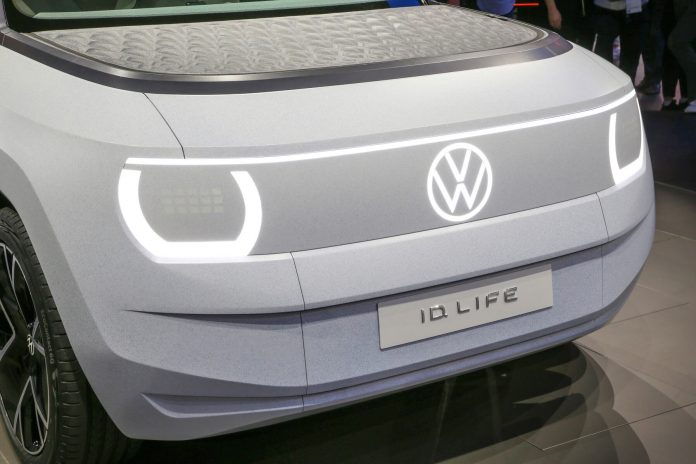
Major automakers are facing a profitability crisis as electric vehicle sales reach record heights, forcing industry giants to confront an uncomfortable reality: manufacturing more EVs is making them less money, not more.
Volkswagen Group’s operating margin collapsed to 3.8% in the first nine months of this year, down from 4.5% during the same period a year ago. Meanwhile, Mercedes-Benz saw its passenger-car operating margin cut in half to 2.5% from 4.8%, even as the company set a quarterly record by selling 68,428 battery-electric vehicles in the third quarter. Ford’s EV division fared worse, posting a staggering operating loss of $1.058 billion on quarterly revenue of just $1.2 billion.
“The more EVs are embraced in the market, the greater the burden on the profit side,” said Volkswagen Group‘s chief financial officer Arno Antlitz, warning that margins in the 3% range are unsustainable for funding future investments.
The squeeze stems from multiple sources. Converting production facilities to manufacture EVs requires massive capital outlays—retrofitting an existing factory line costs hundreds of millions to over $700 million per plant. Legacy automakers cannot simply repurpose existing assembly lines built for engines, transmissions, and exhaust systems. The heavy battery packs that power EVs require specialized high-precision equipment.
Battery costs represent roughly 35% of an electric vehicle’s price, compared to the lower material intensity of internal combustion engines that automakers have perfected over decades. Volatile prices for lithium, nickel, and cobalt add another layer of cost uncertainty, making it difficult for manufacturers to control expenses.
The industry’s structural burden is particularly acute for established players. While they ramp up EV production, they must simultaneously maintain existing factories producing gasoline and hybrid vehicles. This dual-track production system strains profitability and forces companies to fund two separate technological ecosystems.
Aggressive price competition exacerbates these margins. Chinese manufacturers willing to accept razor-thin profits to capture international markets have triggered a discount war. Kia boosted third-quarter EV sales by 75.4% year-over-year, but expanded incentives and price cuts consumed 727 billion won (approximately $540.6 million) in potential profit—with an additional 465 billion won lost due to a product mix weighted toward lower-margin models.
General Motors offers a contrasting case study. The company’s U.S. electric vehicle sales fell 62% in the third quarter, yet its adjusted operating margin improved to 8.2% from 6.9%. By deliberately reducing EV sales and shifting focus to higher-margin large pickup trucks, GM protected its bottom line—a strategy that highlights the tension between electrification targets and profitability.
Yet exiting the EV business is not a viable option for most manufacturers, particularly in Europe. Regulatory mandates on carbon emissions make electric vehicles essential for compliance, while surging fuel costs tied to geopolitical tensions have increased consumer demand. European EV sales exceeded 1.22 million units in the first half of this year, up more than 40% from the prior year.
The path forward depends on one critical factor: achieving economies of scale. Tesla has demonstrated that mass-producing a focused lineup of EV models can dramatically reduce costs and improve profitability. For traditional automakers managing complex portfolios across multiple regions and powertrains, reaching that efficiency level remains a distant goal.
Industry observers say the question has fundamentally shifted. The metric that matters is no longer “how many vehicles you sell” but rather “how much profit you retain per sale.” As electrification accelerates, the automakers that master their cost structures and production efficiency will emerge as winners, while those unable to optimize their operations face continued margin erosion despite growing sales volumes.

