
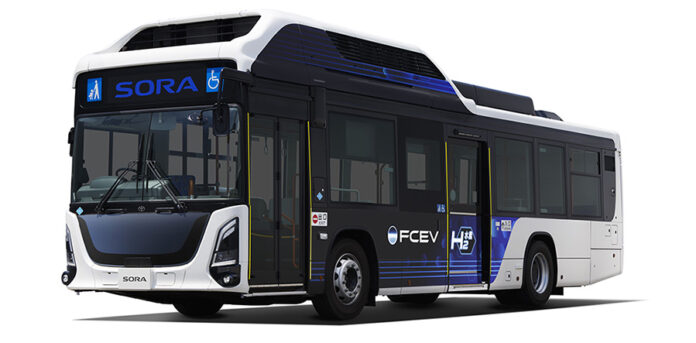
Toyota has introduced an upgraded version of its hydrogen-powered route bus, the “Sora,” featuring extended driving range, improved efficiency, and a significantly lower price tag than its predecessor. Developed jointly with Isuzu Motors Limited, the second-generation Sora represents the first major redesign since the original debuted in 2018.
The new bus combines Toyota’s fuel cell system with Isuzu’s battery-electric flat-floor platform, which Isuzu will sell under the name “Erga FCV.” The vehicle addresses a critical challenge for hydrogen-powered public transportation: delivering practical range and quick refueling capabilities that meet the demands of daily transit operations.
Performance and Range Improvements
The redesigned Sora achieves a driving range exceeding 300 kilometers—approximately 100 kilometers more than the first-generation model—despite using about 20% less hydrogen tank capacity. Toyota attributes this improvement to more efficient use of the fuel cell system paired with a large-capacity battery, alongside a new compact fuel cell stack that offers increased output and durability.
Hydrogen refueling takes approximately 10 minutes, enabling the high vehicle utilization required for commercial bus operations. Toyota notes that a faster hydrogen refueling standard under development could reduce this time by about half once compatible hydrogen stations are deployed.
Design and Safety Features
The compact roof-mounted fuel cell system simplifies vehicle maintenance for bus operators. The urban model accommodates 70 passengers—19 seated and 50 standing—plus one crew member.
Safety enhancements include an Emergency Driver Stop System linked to driver monitoring that automatically decelerates and stops the bus if the driver experiences a problem, with automatic parking brake engagement to prevent rollback on slopes. A front blind-spot monitor detects pedestrians and bicycles, helping reduce accidents.
Accessibility and Versatility
The full-flat floor design allows all passengers, including those using wheelchairs or strollers, to board and move safely without steps. A one-touch wheelchair securement system (available from April 2027) assists both passengers and drivers. Four variants with different seat layouts are available to meet diverse urban and suburban operational needs.
The bus can serve double duty as an emergency power source during disasters through an external power supply connection.
Market Impact and Pricing
The new Sora costs approximately ¥79.8 million (roughly $510,000) before tax—a 20% reduction from the first-generation’s approximately ¥100 million price point. Cost savings resulted from reducing hydrogen tanks from 10 to 3 units and utilizing Isuzu’s established chassis platform.
Approximately 200 first-generation Sora buses currently operate worldwide, primarily on route bus services. The lower price and extended range aim to increase adoption among local governments and bus operators considering hydrogen-powered solutions for decarbonizing public transportation.
Broader Hydrogen Strategy
Toyota has supplied more than 3,500 fuel cell systems to over 100 customers worldwide since 2019, spanning applications including buses, rail transport, and stationary generators. The automaker introduced its Mirai hydrogen fuel cell passenger vehicle in 2014 and continues expanding hydrogen technology across its commercial vehicle lineup as part of its strategy to realize a hydrogen-based society.

