
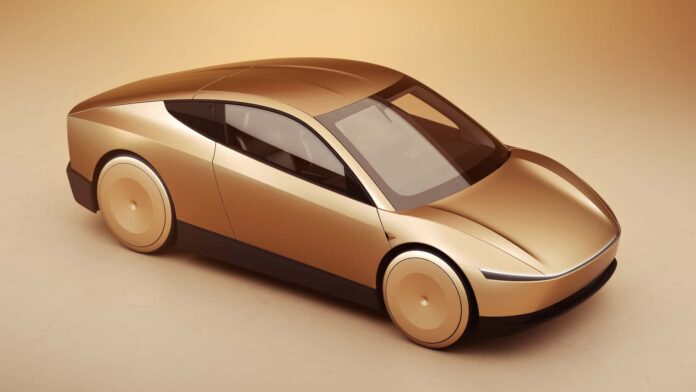
Tesla has developed a Cybercab motor that contains no rare-earth metals while maintaining the vehicle’s driving range, CEO Elon Musk said, highlighting a potential new way for automakers to reduce dependence on China’s strategically important mineral supply chains.
The two-seat, fully autonomous Cybercab entered Tesla’s limited robotaxi service in Austin, Texas. The vehicle has no steering wheel, pedals or traditional side mirrors and began production in early 2026.
Rare-earth elements are widely used in electric-vehicle motors, consumer electronics, military equipment and industrial machinery. China dominates the sector, accounting for about 90% of global rare-earth refining and processing, including most supplies of praseodymium, neodymium, dysprosium and terbium.
Tesla’s motor design marks a return to rare-earth-free technology after the company shifted from induction motors to rare-earth permanent-magnet motors in the Model 3. Permanent magnets generally offer greater power density and efficiency, allowing vehicles to achieve longer range without larger battery packs.
According to market research firm Mysteel, Tesla combined several established technologies to offset the weaker magnetic performance of non-rare-earth materials. These include Halbach magnet arrays, which concentrate magnetic flux; hairpin stator windings, which increase the amount of copper in the motor; and operating speeds above 15,000 revolutions per minute.
Ferrite, a low-cost and widely available magnetic material, is considered a likely candidate for the replacement magnets, although Tesla has not disclosed the motor’s exact composition. Ferrite has roughly one-tenth the magnetic energy product of neodymium-iron-boron, the industry’s standard high-performance magnet material.
The approach has drawn skepticism from the rare-earth industry. Chinese magnet supplier JL MAG Rare-Earth said high-performance rare-earth magnets remain difficult to replace in applications requiring compact size, low weight and high torque density. The company said such magnets remain important for electric vehicles, humanoid robots and industrial equipment.
Some analysts also questioned whether Tesla’s design can match conventional motors in efficiency and performance, particularly at high speeds. David Zhang of the International Intelligent Vehicle Engineering Association said rare-earth permanent-magnet motors are likely to remain the leading technology for new-energy vehicles in the coming years. Xu Tianchen of the Economist Intelligence Unit said it was too early to conclude that Tesla’s development had weakened China’s influence over rare-earth supplies.
The motor does not eliminate rare earths from electric vehicles altogether. The materials are also used in sensors, displays, infotainment systems and other electronic components. In addition, the rare-earth-free design currently applies only to the Cybercab’s limited fleet, and Tesla has not provided detailed information about its weight, size or performance under demanding conditions.
Japan’s experience shows both the potential and limits of reducing dependence on China. After a 2010 dispute sharply disrupted rare-earth shipments, Japan expanded supplies from other countries, invested in substitution technologies, built strategic reserves and increased recycling. China’s share of Japan’s rare-earth imports fell from 85% in 2009 to 58% by 2020, but new export restrictions have continued to create pressure in sectors such as semiconductor manufacturing.
Automakers have already developed magnets that eliminate dysprosium and terbium—heavy rare earths over which China has especially strong control—while retaining neodymium. Tesla’s claim is broader because it removes rare-earth materials from the drive motor entirely.

