
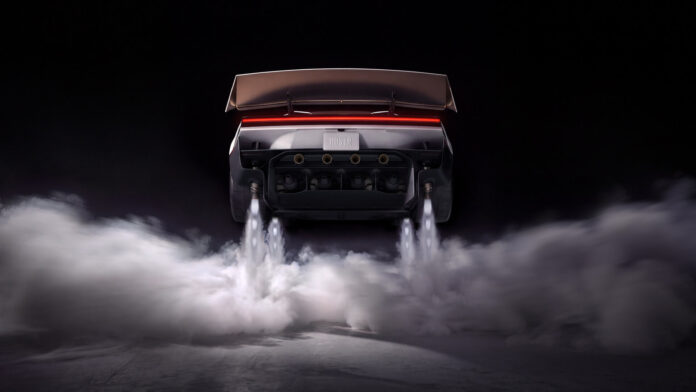
Tesla’s cold-gas thruster technology, first shown on the second-generation Roadster unveiled in October, is drawing growing interest as a possible automotive safety device. The system could help keep vehicles on course when tires lose grip on ice, snow, or water.
Today’s cars rely on electronic stability control (ESC), anti-lock brakes, traction control, and similar systems. All of them depend on friction where the tire meets the road. When a surface is covered with water, gravel, ice, or snow, these systems have little to work with. Even a well-equipped car on new tires can slide into a guardrail on black ice.
Cold-gas thrusters take a different approach. They fire high-pressure gas in one direction, and the recoil pushes the vehicle in the opposite direction. The principle is the same as rocket propulsion, based on Newton’s laws of motion and conservation of momentum. Because it does not depend on road contact, it works in any weather, at any time of day, and even in the vacuum of space.
At the October unveiling, the Roadster rocket raced up a C-shaped ramp roughly as tall as a six-storey building. It launched off the edge upside down, rotated halfway in midair, and landed while using its thrusters to control its descent. Although the stunt drew strong applause, experts emphasize that the control technology behind it has more significant safety implications.
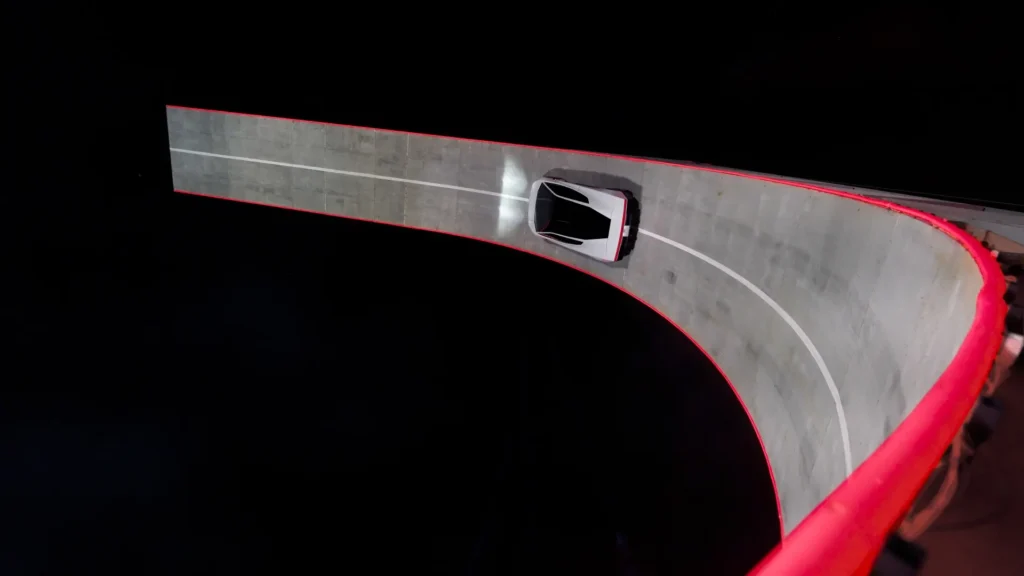
Potential uses include stabilizing a car that has begun to slide and keeping it on the road. Other proposed applications include improving lane keeping and emergency evasive maneuvers, slowing a vehicle before a collision, and moving a car stranded on a railway crossing before a train arrives.
German auto parts maker Bosch demonstrated the concept in 2018 by fitting a gas thruster to a motorcycle. The system detected excessive sideways skidding and fired gas to restore balance, which showed it could prevent falls and crashes. However, Bosch’s prototype was single-use and needed replacing after each firing. Tesla’s design differs in several ways:
| Feature | Bosch (2018 verification) | Tesla (new Roadster) |
|---|---|---|
| Vehicle type | Motorcycle | Passenger car |
| Purpose | Suppressing sideways skids and preventing falls | Aerial maneuvers, landing control, and a possible safety device |
| Gas supply | Single-shot, replaced after release | Compressed air in a carbon-fiber pressure vessel that can be refilled |
| Continuous use | Not possible | The tank reportedly empties within a few seconds |
Tesla’s tank can be refilled, but refilling is believed to take considerable time, which limits how often the system could be used in succession.
Adoption on public roads faces significant hurdles. Critics argue that regulators would be unlikely to approve a system that could blow gas onto other vehicles, obstruct the view of drivers behind, or rupture a high-pressure tank in a crash. Engineers must also make the system affordable, refillable, and reliable, and must assess the risks of exhaust jets, noise, flying debris, and malfunctions. Some observers also question whether using thrusters to jump over a slower car to overtake it would be ethically acceptable.
Early systems are expected to be low-output, intervening moderately when a car starts to slip and keeping it from deviating far from its intended path. Acting early requires less force, and stopping a sliding car is considered much easier than controlling a spin. Nozzles at the front of the vehicle could also serve as a deceleration aid.
Tesla, which is expanding into energy storage and power trading, may build on its control expertise. If cold-gas thrusters are adopted in mass-production cars, they could create new demand for parts suppliers while affecting existing ESC manufacturers, either as a complement or a substitute.
The feasibility of using high-pressure gas to move a car and change its path has already been demonstrated. The remaining question is whether engineers can make the technology affordable, safe, and practical enough for everyday driving.

