
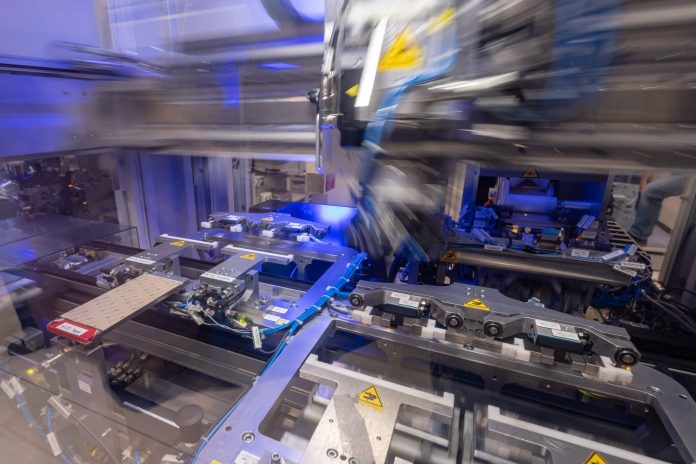
A consortium of nine Japanese equipment makers has launched Swiftfab Energy Systems, a joint venture that plans to deliver standardised, container-sized battery-production modules to cut battery-factory costs and construction time and help Japanese suppliers compete with China’s dominant battery industry.
Formed in April by members of the Battery Association for Supply Chain (BASC), Swiftfab’s founding companies include Hitachi, Ricoh, Toyota-affiliated Jtekt, Komatsu NTC (a Komatsu subsidiary) and Seibu Giken. The venture will design and assemble production equipment into shipping-container-sized modules that customers can combine into full manufacturing lines covering material processing, electrode fabrication, cell assembly and electrolyte filling.
Swiftfab says roughly 1,000 modules would be needed to assemble a facility capable of producing batteries for about 50,000 electric vehicles a year. By standardising components, coordinating specifications across suppliers and taking over joint procurement of common parts such as sensors and motors, the company aims to dramatically reduce the complexity and delays that arise when a conventional factory requires coordination among 50-plus suppliers.
The JV argues the modular approach can slash the typical four- to six-year lead times for battery-plant construction to two to three years, while lowering both upfront capital and operating costs after start-up. Executives and analysts cited by Nikkei Asia report the venture is targeting as much as a 70% reduction in total factory construction costs versus traditional methods — a claim that, if realised, would substantially narrow the cost-and-speed advantages that helped Chinese manufacturers scale quickly and capture large market share.
Swiftfab expects to receive government subsidies and plans to have its first modular factory in operation by the end of 2030. Hitachi is playing a prominent role in the initiative’s digital capabilities: the company intends to supply simulation and “digital twin” technology to debug and optimise production lines digitally before modules ship, reducing on-site adjustments and improving overall equipment effectiveness.
Proponents say the containerised model also offers strategic flexibility. As battery chemistries evolve — with contenders such as solid-state and sodium-ion under development — a modular line could be reconfigured more easily than a fixed gigafactory, lowering the risk of costly retooling. The approach may also enable smaller, regional plants that are economically viable without the scale and capital of conventional gigafactories, a proposition attractive to automakers and governments seeking to diversify supply chains away from concentrated Chinese production.
Despite the potential advantages, the plan faces tests. Japanese suppliers currently account for a modest share of global battery-equipment markets, and China’s manufacturers have repeatedly shown an ability to replicate and scale competitive industrial concepts quickly. Observers note that once proven, the modular idea would likely be imitateable, meaning Swiftfab will need to maintain performance, speed and cost edges—particularly via its digital simulation tools and coordinated procurement—to secure lasting advantage.
Swiftfab’s backers position the JV as a means to strengthen Japan’s battery-equipment industry by consolidating design, production and systems expertise under one platform, sharing successes with BASC members and improving domestic supply-chain resilience. If the venture can deliver on faster deployment, lower costs and operational flexibility, it could offer a credible alternative path for regions aiming to localise battery production — but its ultimate impact will depend on execution and how competitors respond.

