
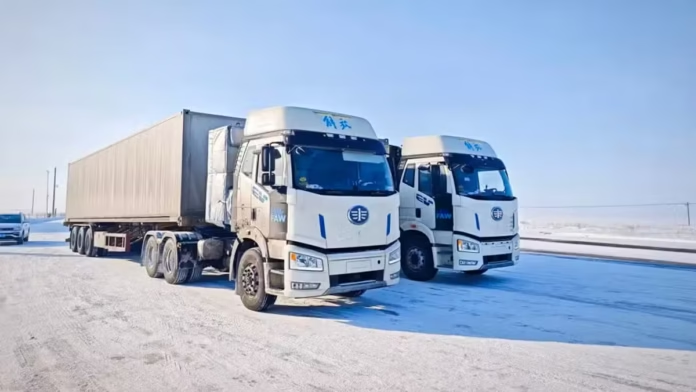
FAW Jiefang, the truck-making unit of FAW Group, has completed full-condition systematic testing of a sodium battery heavy truck, marking a key breakthrough for the new battery technology in the heavy-duty commercial vehicle sector.
FAW Jiefang conducted the tests in cooperation with Chinese sodium-ion battery maker Hina Battery, work that could offer an alternative to lithium batteries in solving industry challenges such as cold-weather degradation and slow charging for new-energy heavy trucks.
The test model was the Jiefang J6P battery-electric tractor, fitted with a high-capacity 339-kWh sodium-ion battery, according to a statement from FAW Jiefang on Thursday.
The testing ran for nearly 7 months, with cumulative road-test mileage surpassing 15,000 kilometers and closely tracking real-world user operating scenarios, FAW Jiefang said.
The tests covered bench trials, vehicle reliability trials, power performance trials and extreme high- and low-temperature environmental assessments.
FAW Jiefang said the tests fully validated the operating-condition adaptability, running quality and overall safety of the vehicle equipped with sodium batteries.
In an extreme cold environment of -40°C, the battery can still retain more than 90% of usable capacity, suiting freight needs in the cold regions of northeast and northwest China.
The truck needs only 20 to 25 minutes to fully charge, and the battery has a cycle life of more than 8,000 cycles under fast-charging conditions, far exceeding conventional industry standards, FAW Jiefang said.
The truck maker also said the chemical system of sodium-ion battery materials is milder and offers outstanding thermal stability, matching the high-frequency, heavy-load operating needs of commercial vehicles.
The progress places FAW Jiefang within the broader race to commercialize sodium batteries in China, as the industry seeks alternatives to lithium that balance cost and performance.
Hina Battery general manager Li Shujun has previously predicted that sodium battery prices could catch up with lithium batteries in 2027 or 2028.
He said sodium battery costs are falling rapidly while lithium prices are rising, and the price ranges of the two will converge.
Industry giants are also accelerating their plans. CATL (HKEX: 3750) plans to invest 5 billion yuan ($735 million) to build 40 GWh of new sodium-ion battery capacity in Fujian, according to a regulatory filing last month.
In late April, CATL secured a 60 GWh sodium battery order for energy storage, setting an industry record.
BYD (HKEX: 1211) has said it has developed a sodium battery with a cycle life of up to 10,000 cycles, while BAIC Group has unveiled sodium battery samples with energy density exceeding 170 Wh/kg.
FAW Jiefang said that going forward it will continue to deepen its work in new-energy technology, refine its new-energy heavy truck product lineup and support the green, low-carbon transition of the logistics industry.
This article was first published by Phate Zhang on CnEVPost, a website focusing on new energy vehicle news from China.

