
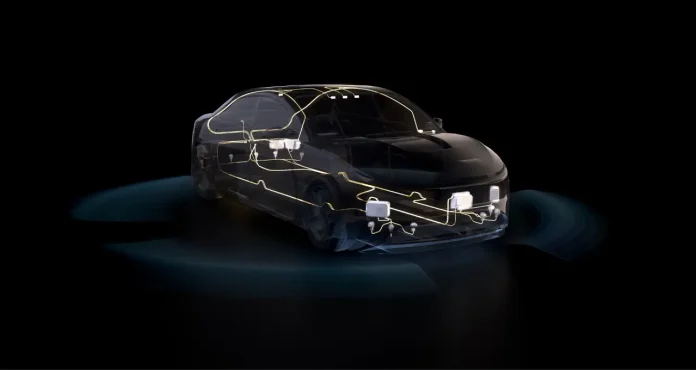
On January 5, 2026, at CES, NVIDIA unveiled the Alpamayo family a comprehensive suite of open-source AI models, simulation tools, and datasets designed to accelerate the development of safer, more intelligent autonomous vehicles (AVs). Nvidia said the initiative marks a significant shift toward “physical AI,” where machines not only perceive their environment but also reason and act with human-like judgment to navigate the real world’s complexities.
The Core Challenge: Mastering the “Long Tail”
A primary obstacle for AVs has been handling rare, unpredictable scenarios—the so-called “long tail” of driving. Traditional AV systems, which separate perception from planning, often struggle with novel situations outside their training data. While end-to-end learning has advanced the field, true safety and scalability require models that can reason through cause and effect. The Alpamayo family directly addresses this by introducing chain-of-thought reasoning into vision-language-action (VLA) models, allowing vehicles to analyze unfamiliar scenarios step-by-step, make informed decisions, and even explain their logic. This transparency is critical for building public trust and achieving higher levels of autonomy.
A Trio of Foundational, Open-Source Tools
NVIDIA’s approach integrates three pillars into a cohesive ecosystem for developers and researchers:
- Alpamayo 1: Released on Hugging Face, this is the industry’s first open reasoning VLA model specifically for AV research. With 10 billion parameters, it processes video input to generate driving trajectories paired with “reasoning traces” that document its decision-making logic. Developers can fine-tune or distill this large “teacher” model into efficient runtime models for vehicles or use it to create advanced tools like auto-labeling systems.
- AlpaSim: A fully open-source simulation framework on GitHub for high-fidelity AV testing. It offers realistic sensor modeling, dynamic traffic scenarios, and scalable closed-loop testing to enable rapid validation and refinement of autonomous driving policies in a safe, virtual environment.
- Physical AI Open Datasets: Hosted on Hugging Face, this is described as the most diverse large-scale open dataset for AVs, featuring over 1,700 hours of driving data from a wide range of geographies and conditions. It is particularly rich in rare “edge cases,” providing the essential fuel for training and testing reasoning-based AI architectures.
Industry Endorsement and Strategic Impact
The announcement has garnered strong support from major mobility players and researchers, who see Alpamayo as a catalyst for achieving Level 4 autonomy. Companies like JLR, Lucid Motors, and Uber emphasized the importance of its open-source nature for responsible innovation and tackling unpredictable driving challenges.
NVIDIA CEO Jensen Huang positioned this moment as the “ChatGPT moment for physical AI,” signaling a new era where AI begins to intelligently interact with the physical world. By open-sourcing Alpamayo, NVIDIA aims to establish a collaborative foundation for the entire industry. Developers can further integrate these models with NVIDIA’s broader ecosystem—including DRIVE Hyperion and Omniverse—for end-to-end development, from fine-tuning on proprietary data to validation in simulation and final deployment on NVIDIA’s DRIVE AGX Thor compute platform.

