
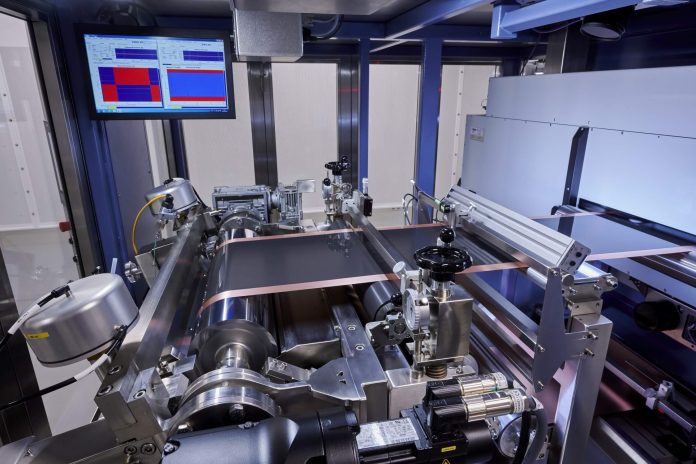
- Development of a next-generation high-performance battery anode manufacturing technology that overcomes the limitations of conventional dry-electrode processes
- Expected to enable longer EV driving ranges and fast charging while demonstrating the commercialization potential of environmentally friendly battery manufacturing processes
Korea Institute of Materials Science (KIMS), led by President Chul-jin Choi, announced that a research team led by Jihee Yoon of the Advanced Materials Research Division, in collaboration with a team led by Insung Hwang of Korea Electrotechnology Research Institute (KERI), has developed Korea’s first shape-controlled graphite granule-based dry electrode manufacturing technology capable of producing high-performance batteries without using polytetrafluoroethylene (PTFE), a key material in conventional dry-electrode processes. The technology is expected to extend electric vehicle (EV) driving range, reduce charging time, and accelerate the commercialization of next-generation environmentally friendly battery manufacturing processes.
As demand for electric vehicles and energy storage systems (ESS) continues to grow, competition to develop high-energy-density batteries with longer operating life and faster charging capabilities has intensified. In particular, dry-electrode technology, which minimizes the use of organic solvents and drying processes during battery manufacturing, has emerged as a promising next-generation production method. Although dry-electrode technology offers significant advantages in reducing manufacturing costs and carbon emissions, most existing approaches rely heavily on PTFE, making the development of alternative technologies a critical challenge.
PTFE serves as a key binder material that holds together the various components of a dry electrode. However, it may cause performance degradation in anode environments and has attracted increasing attention due to environmental concerns associated with fluorinated materials. While it has long been considered difficult to manufacture dry electrodes without PTFE, the research team successfully developed a high-performance PTFE-free dry anode by applying a CMC-SBR binder system, which is widely used in commercial wet-electrode manufacturing, and redesigning the structure of graphite particles.
The researchers produced composite graphite granules through a spray-drying process using a slurry composed of graphite, conductive additives, and binders. During granulation, conventional plate-like graphite particles were assembled into granules with a randomly oriented, isotropic internal architecture rather than the highly aligned structure typically formed during conventional electrode processing. This isotropic arrangement created multidirectional lithium-ion transport pathways, including through-plane pathways across the electrode thickness, thereby reducing orientation-induced transport limitations. As a result, the morphology-engineered granules mitigated the performance degradation commonly observed in thick dry electrodes during charge–discharge cycling.
Experimental results demonstrated that the developed dry anode exhibited superior fast-charging performance and long-term cycling stability compared with conventional slurry-based anodes. The technology also significantly improved lithium-ion diffusion characteristics under high-energy-density conditions, confirming its potential for enabling high-capacity batteries based on thick-electrode architectures. These results provide a technological foundation for batteries capable of delivering both extended driving range and rapid charging.
The technology is expected to find applications in electric vehicles, energy storage systems, and next-generation high-energy-density batteries. In particular, it could contribute to longer EV driving ranges and fast-charging technologies, positioning it as a key technology for the future battery industry. Furthermore, because the technology utilizes the CMC-SBR binder system already widely adopted in industry, it offers advantages for large-scale manufacturing. By minimizing solvent use and drying processes, it also has the potential to reduce manufacturing costs and carbon emissions.
“This technology presents a new approach capable of overcoming the limitations of conventional PTFE-based dry-electrode processes,” said Jihee Yoon, senior researcher at Korea Institute of Materials Science. “We expect it to be highly applicable to next-generation EV batteries that require both high energy density and fast-charging performance.”

