
Hyundai Motor Group plans to begin applying its in-house autonomous-driving artificial intelligence system, Atria AI, to mass-produced vehicles in 2029, executives said at the company’s 2026 CEO Investor Day in Seoul on Aug. 26.
Atria AI uses a single end-to-end model to connect road perception, decision-making and vehicle control. Hyundai Motor and Kia executives said the system will be supported by an explainable AI “guardrail” designed to help address errors and unpredictable outputs.
Before Atria enters production, Hyundai’s first software-defined vehicle, scheduled for launch in 2028, will use Level 2+ autonomous-driving technology developed with Nvidia. Level 2+ systems can support hands-free driving in certain highway conditions, although drivers remain responsible for monitoring the road and taking control when necessary.
Hyundai plans to expand its autonomous-driving lineup from Level 2+ toward Level 4, a stage in which vehicles can operate without human control in defined conditions. The company will initially deploy about 200 vehicles in an urban demonstration project in Gwangju by the end of 2026 to collect data on unexpected driving situations.
The group’s strategy relies on a “data flywheel” in which real-world driving data is collected, used to train and improve AI systems, and distributed back to vehicles through over-the-air software updates. Hyundai said its annual sales of more than 7 million vehicles across more than 190 countries provide a large potential source of data.
Park Min-woo, president of Hyundai Motor and Kia’s autonomous-vehicle platform division and chief executive of 42dot, said the group expects to surpass competitors in cumulative autonomous-driving data around 2033.
Hyundai Motor, Kia, 42dot and Motional are standardizing sensor systems and developing a common framework for combining data collected across the companies. A 100-megawatt artificial-intelligence data center in Saemangeum is scheduled to begin operating in 2029. It is designed to handle more than 50,000 graphics-processing units and manage data collection, validation and distribution.
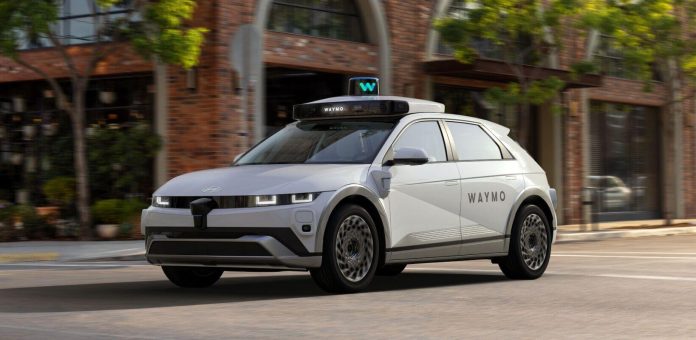
The group is also expanding its autonomous-vehicle contract manufacturing operations. Hyundai Ioniq 5-based robotaxis made at Hyundai Motor Group Metaplant America are scheduled to be supplied to Waymo beginning in the fourth quarter of 2026. Motional, a Hyundai-backed autonomous-driving joint venture, plans to commercialize Ioniq 5 robotaxis with Uber in Las Vegas by the end of the year and later expand into Europe and the Asia-Pacific region.
Hyundai will begin deploying Boston Dynamics’ Atlas humanoid robots at U.S. production facilities in 2028. It plans to establish robot production facilities with annual capacity of 30,000 units and has secured an initial supply volume of 25,000 robots, much of which is expected to be used within the group.
The company also plans to introduce its Pleos Connect infotainment system and Gleo AI generative-AI assistant, beginning with the Grandeur facelift. Hyundai said vehicle data and over-the-air updates will be used to improve the system and add features.
By 2030, Hyundai Motor Group aims to launch more than 100 new models, sell 5.55 million vehicles globally and achieve an operating margin of at least 9%. It has not decided whether Boston Dynamics will pursue an initial public offering, an executive said.

