
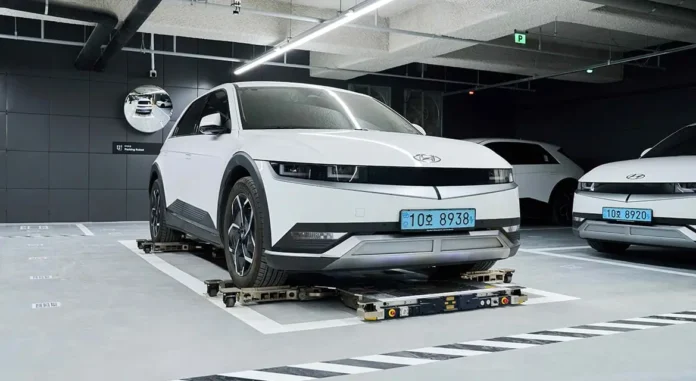
Hyundai Motor Group has launched South Korea’s first demonstration project for autonomous parking robots aimed at relieving chronic parking shortages in apartment complexes and improving safety inside underground garages.
The pilot is being carried out at “Hillstate The Wave City” in Siheung, Gyeonggi Province, where a regulatory sandbox project approved by the Ministry of Land, Infrastructure and Transport will test the system in a real residential setting. The consortium includes Hyundai Motor, Hyundai Wia, and Hyundai Engineering & Construction, with the demonstration supported by government funding.
The robots will operate in a designated 53-space area on the first basement level of the apartment’s parking facility. Hyundai Wia will supply two sets of the robots used in the trial. Each robot is designed to be extremely thin—about 110 millimeters—so it can slide under a vehicle. Once positioned, the robots lift the car by its wheels and transport it autonomously to an available spot.
Equipped with LiDAR sensors, the robots can detect the size and position of vehicle wheels to support stable lifting. Hyundai Wia says the system is intended to handle sport utility vehicles weighing up to 3.4 tons and can move at speeds up to 1.2 meters per second. The robots can also travel in multiple directions—forward, backward, left, and right—allowing them to maneuver in tight spaces where human drivers may struggle.
In the proposed workflow, residents exit their cars at a designated drop-off area within the complex. The vehicle can then be summoned through a kiosk or apartment wall-mounted smart controls, after which the robots move the car to an open space. For retrieval, residents request the return of the vehicle, and the system delivers it to the pickup zone around the time they step out of the elevator.
Hyundai Motor Group expects the robot-based system to increase parking capacity by 20% to 50% within the same floor area. Company officials attribute the gain to eliminating the time drivers spend searching for empty spaces and reducing the need for wide clearance areas for door opening and manual maneuvering. They also say the approach can better separate vehicle movement from pedestrian areas in garages, lowering accident risk. The company further expects reduced vehicle idling and less unnecessary movement, which it says could benefit the environment through lower emissions and fine dust.
During the demonstration period, the consortium plans to track performance and operational metrics including entry and exit times, resident wait times, parking success rates, robot utilization levels, and changes in parking-space efficiency. The data will be used to propose improvements to rules and regulations governing robot-assisted parking, while researchers will also build virtual environment models to optimize parking layouts for different types of facilities, ranging from residential and commercial buildings to transportation hubs and public venues.
Hyundai Wia also said it plans to expand testing and deployment beyond this initial site. Future rollout targets include redeveloped apartment complexes in southern Seoul’s Apgujeong neighborhood, with one zone planned to include emergency-response features tied to fire detection in parking garages. The company has additionally indicated it intends to bring the service to transit hubs, commercial centers, and public facilities.

