
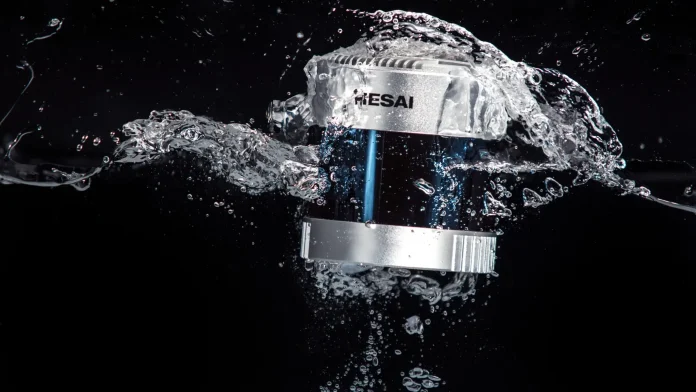
China’s Hesai Technology, a global leader in lidar technology, debuted its ATX model last year with a plan to start delivery in the first half of 2025. As mass production is already ramping up, making a lidar sensor available for as low as $200, automakers are expected to adopt lidar more broadly as they seek to equip more safety features and advanced vision capabilities in their automated-driving vehicles.
Hesai, which has quickly risen to become a leader in the global lidar market, believes its groundbreaking price point could challenge Elon Musk’s long-standing stance on the technology, positioning lidar as a standard safety feature in vehicles — much like airbags.
Founded in 2014, Hesai has carved out a dominant position, controlling one-third of the global automotive lidar market. Its sensors are used by 24 automakers, primarily in China, with the company’s latest move aiming to drastically reduce the cost of lidar technology, a key component in autonomous driving systems. Once priced upwards of $10,000 per unit, Hesai’s new $200 lidar model is seen as a game-changer, offering a combination of high safety standards and affordability.
The move comes after several years of collaboration with industry giants like German parts supplier Bosch and American tech company Nvidia. Initially, Hesai sought to bring a lidar model to market for around $500, but after challenges in sourcing components, the company opted to handle production in-house, reducing costs dramatically. By manufacturing critical components like lasers, receivers, and drivers in China, Hesai has slashed the price of its new ATX lidar, making it not only affordable but scalable for mass production.
Musk’s “Dead-End” Prediction Reconsidered
This dramatic cost reduction comes at a pivotal moment in the debate over the role of lidar in autonomous driving. Tesla CEO Elon Musk has long been an outspoken critic of lidar, calling it a “dead-end” technology. Musk’s vision for self-driving vehicles has revolved around cameras and advanced neural networks, dismissing lidar as unnecessary and too expensive. He believes cameras can provide all the necessary data for a vehicle to navigate roads safely, even in low light conditions.
However, Hesai’s CEO, Li Yifan, is confident that the industry is moving in a different direction. “Lidar has been proven to be an excellent technology for stopping vehicles before collisions,” Li stated at the 2023 IAA Mobility Expo in Munich. Data from Hesai’s customers, like Chinese automaker Li Auto, shows that vehicles equipped with lidar are able to avoid up to 90% of fatal accidents on highways and 20% of collisions on regular roads.
While companies like XPeng and Baidu have moved away from lidar, Hesai’s stance reflects a growing consensus among global automakers. Nearly 100 companies, including major European manufacturers, now consider lidar an essential component for safety and autonomy. In particular, European automakers have embraced lidar for developing Level 3 autonomous driving, a system that allows for hands-free driving under certain conditions.
A $200 Lidars as Standard Equipment
For Li Yifan, the goal is clear: make lidar as ubiquitous as airbags. “Airbags, once prohibitively expensive, are now standard equipment on all vehicles,” he said, drawing a parallel between the two technologies. Hesai’s ultimate ambition is to see its lidar sensors become as integral to vehicle safety systems as airbags, offering protection not only in collisions but also in preventing them altogether.

Hesai’s new ATX lidar, priced at just $200, could be a critical step in achieving this vision. By reducing the cost of lidar sensors by 99.5% from their initial market prices, the company has made it feasible for automakers to integrate them into a broader range of vehicles, including more affordable models. Hesai aims to produce over 1 million units annually from its Chinese facilities, with plans to expand further with an overseas plant in Southeast Asia by 2026.
Global Expansion and the Road Ahead
While Hesai’s primary market remains China, the company has started gaining traction abroad. A recent collaboration with a Toyota joint venture in China marks a significant step in the global expansion of its lidar technology. European automakers, particularly those focusing on advanced driver-assistance systems (ADAS) and autonomous vehicles, are increasingly turning to Hesai’s sensors to meet safety standards for autonomous driving.
The company’s global reach will only grow with its ongoing efforts to ramp up production and raise funds through its recent listing on the Hong Kong Stock Exchange, where it raised over $500 million to support further expansion.

