
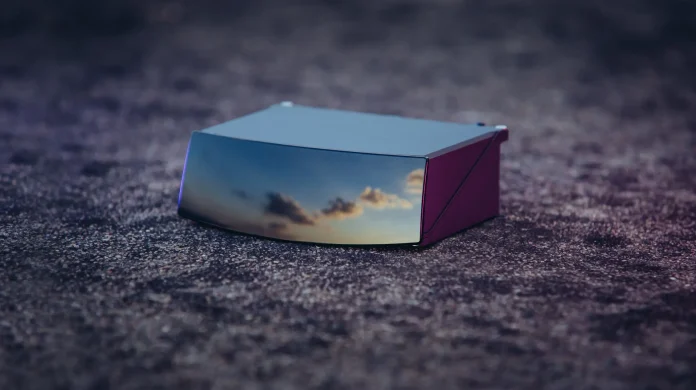
Chinese sensor maker Hesai Group on Friday announced what it describes as the industry’s first full‑colour LiDAR chip, a development the company says will add native colour perception to three‑dimensional distance sensing and accelerate vehicle-level adoption of advanced driver assistance systems.
Named Picasso, the new system‑on‑chip integrates colour detection with ranging at the hardware level, enabling sensors to output colourized 3D point clouds without post‑fusion of separate camera and LiDAR data. Hesai says Picasso supports up to 4,320 laser channels and 4K‑class perception, and achieves a photon detection efficiency (PDE) of more than 40%, a figure the company positions at the top of international competitors. According to Hesai, that higher sensitivity allows the sensor to “see” farther and capture smaller targets with the same laser power.
Hesai plans to equip its next‑generation ETX series LiDAR with Picasso. The ETX family will be offered in multiple channel configurations — 1,080, 2,160 and 4,320 — and is expected to enter mass production and begin deliveries to automakers in the second half of 2026, with vehicle integrations anticipated in flagship models by 2027. Hesai also said it will use the chip in a handheld device called Kosmo, marketed as a “physical AI eye” for collecting high‑quality spatial data and training AI world models.
The core claim behind the announcement is practical: adding colour information to LiDAR should let perception systems distinguish road elements that monochrome point clouds struggle with, notably traffic lights, lane markings and construction signage. Company executives and analysts argue that native colour measurement removes the need for complex image‑to‑point‑cloud stitching or computational inference, reducing the chance perception stacks must “guess” object states in safety‑critical situations.
Hesai’s unveiling comes amid a broader industry debate over sensor approaches to autonomy. While firms such as Tesla pursue camera‑only stacks and rely on neural vision models, many automakers and suppliers favor multi‑sensor fusion. Hesai’s new product is positioned to strengthen that multi‑sensor camp, with the company already a significant supplier to major Chinese electric vehicle makers and a partner within Nvidia’s ADAS ecosystem.
The launch was announced as Hesai reports improving fundamentals. The company recorded a net profit of 435.9 million yuan (about $63.9 million) in 2025, reversing a prior loss, and disclosed LiDAR shipments rose roughly 223% year‑on‑year to 1.62 million units. Hesai said it will expand annual production capacity to over 4 million units in 2026 to meet growing demand and to drive down unit costs — a move it argues will allow LiDAR to penetrate lower price tiers, including sub‑100,000 yuan vehicle segments and even two‑wheel EV applications.
Market observers noted the strategic value of colour capable LiDAR for safety and for improving training datasets for “physical AI.” Deutsche Bank highlighted the capability as likely to “significantly enhance” detection reliability, while Hesai executives emphasized that the innovation represents a “zero‑to‑one” leap rather than incremental improvement.
Barriers remain: global LiDAR penetration is still modest, and some automakers continue to test alternative sensor philosophies. Hesai did not disclose which carmakers would receive the first ETX deliveries, though it counts most top Chinese assemblers among its customers. The coming months — as ETX prototypes move toward production and first vehicle integrations are confirmed — will determine how quickly colour LiDAR moves from a technical milestone to a mainstream element of ADAS sensor suites.

