
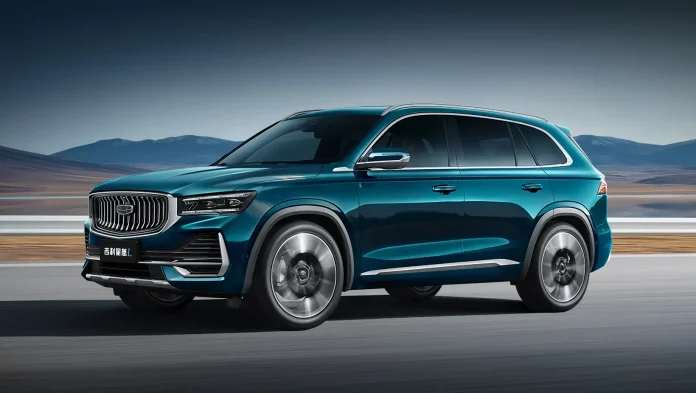
Geely on Monday launched its next‑generation i‑HEV “Intelligent Hybrid” system, positioning the Chinese automaker to challenge long‑standing Japanese dominance in conventional hybrid (HEV) vehicles by prioritizing fuel efficiency, higher electric power and AI‑driven intelligence.
The i‑HEV platform centers on a dedicated hybrid powertrain and an AI energy‑management stack (Xingrui AI Cloud Power 2.0) that Geely says monitors real‑time environmental factors — temperature, humidity and altitude — to optimise energy flow. The hybrid engine records a thermal efficiency of 48.41%, which Geely describes as a new benchmark for mass‑produced engines. In combined testing, a Geely Emgrand fitted with the system achieved a Guinness‑certified highway consumption of 2.22 L/100 km; WLTC figures for flagship models are 3.98 L/100 km (Xingrui/Preface) and 4.75 L/100 km (Monjaro/Xingyue L).
Performance and packaging
- Electric drive: peak 230 kW, about 1.72× the electric power typical of conventional HEVs, giving brisk low‑speed responsiveness (0–30 km/h in 1.84 s).
- Energy gains: Geely says the i‑HEV reduces engine operating time by 27% and improves overall energy efficiency by more than 10% via AI optimisation and a hybrid‑dedicated powertrain.
- Hardware: the system supports multiple hybrid‑dedicated engines (1.5L, 1.5TD, 2.0TD) paired with an integrated 11‑in‑1 electric drive unit and runs on Geely’s GEEA 3.0 electrical architecture with an AI digital chassis and upgraded smart cabin features (DeepSeek model, Huawei smartphone connectivity).
HEVs in China have received less policy support than NEVs (BEVs/PHEVs), leaving the segment long dominated by Japanese makers. Geely’s move aims to close that gap by combining higher electric motor power with software intelligence and aggressive thermal efficiency. The i‑HEV rollout across high‑volume models (Preface/Xingrui, Monjaro/Xingyue L, Emgrand, Boyue) is slated for 2026, signalling a broader hybridisation push for mainstream passenger cars while helping automakers limit exposure to rising battery raw‑material costs—HEV battery packs are typically just 1–2 kWh.
Complementary strategy: methanol as an alternative pathway Alongside hybrid advances, Geely continues to promote methanol fuel as a complementary energy route. Chairman Li Shufu reiterated at the 2026 China Smart Electric Vehicle Development Forum that methanol offers much higher energy density on a weight basis than lithium‑ion batteries and could enable much lighter vehicles — advantages Geely sees as especially relevant for heavy and commercial transport.
Geely has pursued methanol tech for two decades, piloting methanol vehicles, filing methanol PHEV variants, and testing methanol engines in motorsport. Li framed methanol as additive to existing EV adoption rather than a replacement, noting recent Chinese policy moves that broaden support for charging, battery swapping, hydrogen and methanol infrastructure.

