
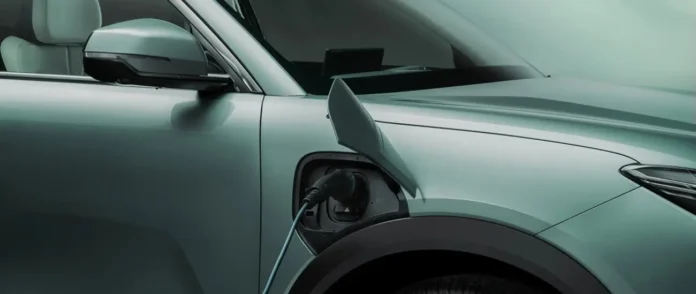
Geely Auto Group has unveiled a new artificial intelligence-powered charging system capable of delivering up to 2.25 megawatts through a single charging gun, intensifying competition among Chinese electric-vehicle makers to reduce charging times.
The company introduced its Geely Smart Charging technology and fifth-generation charging station in Ningbo on Sept. 23. Geely said vehicles equipped with its 12C Shendun Golden Battery can charge from 10% to 70% in 4 minutes and 30 seconds under room-temperature testing conditions. Charging from 10% to 97% takes 8 minutes and 40 seconds.
The Lynk & Co 10 and Zeekr 001 were among the vehicles tested with the battery technology. Geely said the performance represents the fastest charging speed yet achieved by a mass-produced vehicle. Its new charging station has a higher peak output than BYD’s 1.5-megawatt flash-charging system introduced in March.
Geely also unveiled a 6C smart-charging version of the Galaxy E5, which charges from 10% to 70% in 8 minutes and 25 seconds in the company’s tests.
The technology uses Xingrui PowerMind, an energy-focused artificial intelligence model developed with Chinese startup StepFun. The system coordinates the vehicle, battery, charging equipment, grid, energy storage and cloud services to adjust charging strategies for individual vehicles.
Geely said the system can predict battery temperatures up to 30 seconds in advance and dynamically regulate charging power. During high-power charging of the Lynk & Co 10, the battery temperature remained below 55 degrees Celsius for 57% of the charging period and peaked at 64 degrees, according to the company.
A five-point liquid-cooling system covers the charging chain, including the energy-storage battery, power-conversion equipment, charging gun, vehicle charging port and battery pack. Geely also said its lithium-ion pulse-restoration technology could extend battery cycle life by up to 20% by applying small electrical pulses during charging.
The company plans to build more than 22,000 charging stations and over 100,000 charging guns by the end of 2027. More than 15,000 of the stations are expected to use smart-charging technology. Geely aims to provide county-level coverage across China, with stations within roughly 2 kilometers in central areas of first-tier cities and within 3 kilometers in other cities.
Geely currently operates more than 2,500 stations and over 12,000 charging guns across 232 Chinese cities. Its longer-term target is more than 150,000 stations and 600,000 charging guns, including 100,000 smart-charging stations.
The expansion comes as automakers and battery manufacturers accelerate investment in ultra-fast charging. BYD has built 10,000 flash-charging stations and plans to reach 20,000 by the end of 2025. Sunwoda Mobility has proposed building 10,000 megawatt-level flash-charging stations by the end of 2027. CATL has also announced a battery capable of charging from 10% to 80% in 3 minutes and 44 seconds, although mass production is not scheduled until the fourth quarter of 2026.
Megawatt charging creates major demands on local electricity infrastructure. To reduce reliance on immediate grid upgrades, Geely plans to combine solar power, battery storage and charging equipment. Energy can be stored in advance and released when vehicles require large amounts of power.
The company is also opening its charging map to owners of electric vehicles from other brands. Geely said first owners of eligible smart-charging models will receive 2,000 yuan in charging credits over two years.
As concerns grow that ultra-fast charging could shorten battery life, warranties are becoming another area of competition. Geely is extending the battery warranty for vehicles using its smart-charging technology from eight years or 150,000 kilometers to eight years or 200,000 kilometers.

