
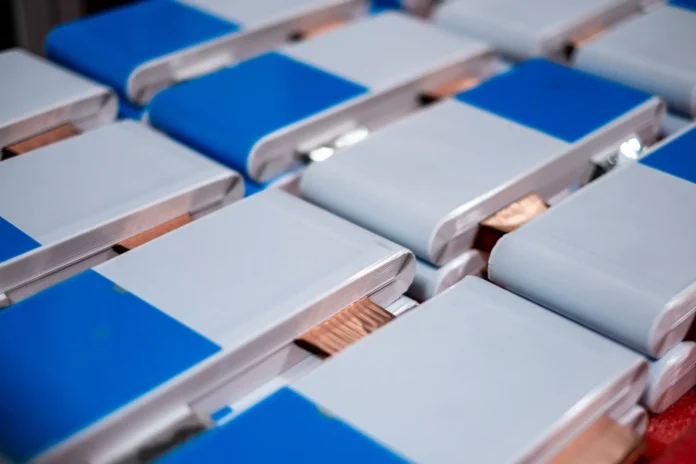
Ford has begun shipping its first lithium iron phosphate (LFP) prismatic battery cells from BlueOval Battery Park Michigan in Marshall, Michigan, to the Louisville Assembly Plant in Kentucky. The cells will power prototypes of the Fathom electric pickup truck. Ford says the shipment marks its entry into battery manufacturing and makes it the first automaker to bring LFP batteries to the mainstream U.S. consumer vehicle market at commercial scale.
Charles Poon, Ford’s vice president of hardware engineering, announced the milestone in a statement on Wednesday. Ford said the plant’s assembly lines can produce 40 cells per minute, which would make them among the fastest prismatic LFP lines outside China. The facility uses AI-powered image recognition to detect defects during production. Ford’s stated goal is to track defects per billion cells rather than per million.
Ford chose LFP technology licensed from CATL, the world’s largest battery maker, whose batteries power about 30 million vehicles worldwide. Ford engineers said they sought a proven, scalable battery that would help make electric vehicles more affordable. LFP chemistry uses no nickel or cobalt, which helps hold down costs, and it is designed to withstand years of charging. The battery pack is also integrated into the vehicle as a structural component of the chassis. Ford says rectangular cells fit directly into the chassis, reducing structural costs, and that combining electrical and sensing connections on a flexible circuit board cuts weight and complexity.
The project has faced significant setbacks. Ford first announced the plant in February 2023 with a $3.5 billion investment and an annual capacity of 35 gigawatt-hours (GWh), with CATL providing technology licensing and operational support. The project was halted that year after U.S. Republican lawmakers questioned whether federal subsidies could indirectly benefit CATL. It restarted in November 2023 with investment reduced to $2 billion and capacity lowered to 20 GWh. In December 2025, Ford recorded $19.5 billion in asset impairment charges tied to policy changes, including the early termination of federal EV tax credits in September 2025. Ford nonetheless kept the LFP project and expanded into battery energy storage. In June 2026, the company said the plant had completed full-process trial production.
Looking ahead, Ford plans to bring a battery pack plant in Marshall into operation in 2027, ahead of the Fathom’s launch. David Carroll, president of Ford Energy, said on Thursday that the Michigan plant’s manufacturing experience is helping a battery energy storage plant in Glendale, Kentucky, prepare for production in 2027. Industry reports say the Marshall plant expects to employ 800 workers by the end of this year, with that number eventually rising to 1,700.
CATL has also confirmed progress. Its vice president, Meng Xiangfeng, said the Michigan plant has begun pilot production, with prototype cells undergoing testing to meet CATL’s quality standards, including a target defect rate of one in a billion. Regular deliveries for Ford electric vehicles are expected later in 2026. Although Ford owns and operates the plant, reports note that CATL employees have assisted with the ramp-up through training and manufacturing expertise.
The shipment comes as Chinese companies continue to dominate the global EV battery market. Between January and September 2026, seven Chinese firms held a combined 73.0% share, up 3.5 percentage points from a year earlier. CATL led with 39.1%, followed by BYD with 15.2%.

