
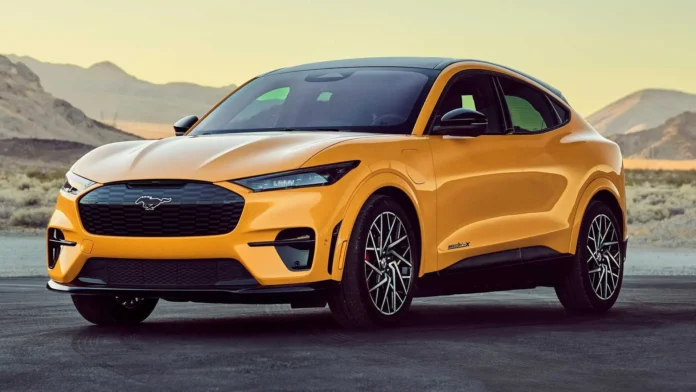
Ford Motor says the batteries in its 2021 Mustang Mach-E electric crossovers have kept an average of 92% of their usable capacity after more than five years on the road. The automaker presents the data as evidence that battery wear in everyday use is milder than many used-EV buyers expect.
The figures cover more than 36,000 vehicles sold to retail and fleet customers in all 50 U.S. states and Canada. Those vehicles have collectively driven about 3.2 billion km (2 billion miles), and the average owner has kept the car for 5.2 years. Ford measures battery “state of health” against a new-battery capacity of 100%. About 95% of vehicles fall between 87% and 97%.
Vehicles with higher mileage show a gradual decline:
| Distance driven | Approximate number of vehicles | Average battery health |
|---|---|---|
| All vehicles studied | More than 36,000 | 92% |
| Over 160,000 km (100,000 miles) | About 2,000 | About 91% |
| Over 320,000 km (200,000 miles) | About 30 | 88% |
Ford also highlighted an owner of a 2022 Mach-E who has driven more than 640,000 km (400,000 miles) on his original battery. Ford has not released a battery health figure for that car, and it is not part of the 2021 dataset.
Battery Design and Charging
Ford says its packs are designed to last at least 10 years. The 2021 model uses an older nickel-cobalt-manganese chemistry, and Ford recommends keeping the charge at roughly 80% to 90% for daily driving to reduce stress on the cells. Newer Ford vehicles use lithium iron phosphate cells, which tolerate occasional full charges, and the company’s upcoming Universal Electric Vehicle platform will use this chemistry.
Independent Comparisons and Caveats
Austrian battery diagnostics firm AVILOO published 2026 research analyzing more than 500,000 EVs from 20 brands. At 150,000 km, it found the Tesla Model Y retained about 90.3% health, the Volkswagen ID.4 about 90.6%, and the Hyundai IONIQ 5 about 92.8%. The first-generation Nissan Leaf was at 86.3%.
Ford’s figures have not been independently verified. The company has not explained how it calculates usable capacity, whether vehicles with replaced battery packs are included, or how many are in Canada. Its warranty treats capacity below 70% of the original level as excessive loss. Canadian coverage runs for eight years or 160,000 km, while the U.S. warranty covers eight years or 100,000 miles.
Ford’s data release does not mention several recalls related to the Mach-E’s high-voltage battery contactors, which can overheat and cause a loss of drive power. The U.S. National Highway Traffic Safety Administration recorded a June 2022 recall of 48,924 vehicles, fixed by a software update, and an October 2023 recall of 34,762 extended-range vehicles, which required replacing the battery junction box. Two smaller follow-up campaigns in 2025 covered 865 more vehicles.
Sales Context
Mach-E sales in the United States have fallen sharply since the federal EV tax credit of up to $7,500 expired on September 30, 2025. Ford sold 1,239 Mach-Es in October, down 57.4% from a year earlier, and 18,445 in the first 10 months of 2026, down 58.9%. Ford’s Model e electric vehicle division lost $1.06 billion before interest and taxes in the third quarter and expects a full-year loss of about $4 billion.
For the 2027 model year, Ford made a larger extended-range battery standard, with 88 kWh of usable capacity on Select and Premium trims and 91 kWh on GT and Rally. The 2027 model starts at $39,995 before destination, $2,200 more than the 2026 version.

