
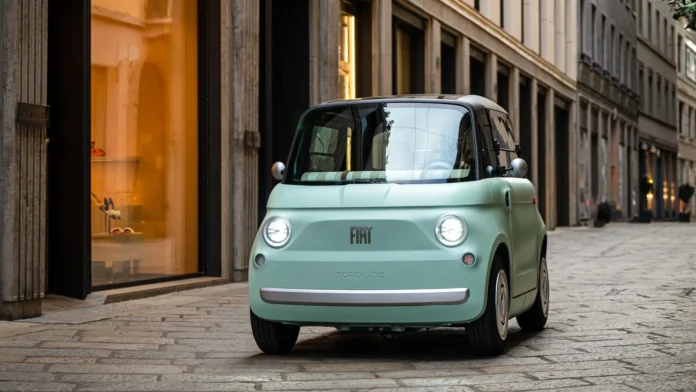
Stellantis has begun taking U.S. orders for the Fiat Topolino, a two-seat electric microcar priced from $13,995—though a required $990 destination fee raises the effective cost to $14,985. The vehicle is aimed at drivers who want an ultra-compact ride for short trips, with Fiat positioning it as an alternative to golf carts for places such as beach towns, resorts, and narrow downtown streets.
The Topolino is classified as a low-speed vehicle, not a conventional car. It is built in Morocco and will be offered in limited quantities this year in two versions: a hardtop model with doors and a “Dolce Vita” soft-top convertible that uses a rope instead of doors.
With a top speed designed to stay within low-speed rules, the Topolino is limited to 19 miles per hour out of the box. A complimentary conversion kit can raise that limit to 25 mph, enabling use on roads with speed limits of up to 35 mph or less. The estimated range is up to 46 miles on a full charge.
The microcar’s lightweight design reflects its niche purpose. It weighs just over 1,000 pounds and is about 8 feet long. Fiat says it does not include air conditioning, a limitation that has become part of the debate over whether the vehicle can find a broader audience in the U.S.
Fiat CEO Olivier Francois has framed the Topolino as a “lifestyle” product rather than a mainstream transportation tool. In comments about the brand’s direction, he said the company does not compete in large, expensive, or luxury categories, emphasizing that it instead focuses on small vehicles designed for emotional appeal as well as practicality for very limited driving needs.
The launch arrives amid long-running challenges for Fiat in the U.S. The brand re-entered the market in 2011 after nearly three decades away, but sales have fallen sharply. In 2025, Fiat sold only about 1,300 vehicles domestically, and it represents far less than 1% of Stellantis’s U.S. total sales.
Still, early dealer reaction has been positive. While some reviews highlight its fit for resort environments, others have questioned its practicality. Critics have noted that it cannot travel on highways and lacks certain features typically expected in everyday vehicles, comparing it more to an accessory-like vehicle than a functional commuter.
Regulators have allowed low-speed vehicles for more than two decades, permitting models that travel roughly 20 to 25 mph and generally do not need doors or air bags, nor are they subject to full crashworthiness testing. They must include safety essentials such as seat belts, headlamps, turn signals, and rearview mirrors, which helps explain why the Topolino’s intended buyers are concentrated in low-speed, short-distance settings.

