
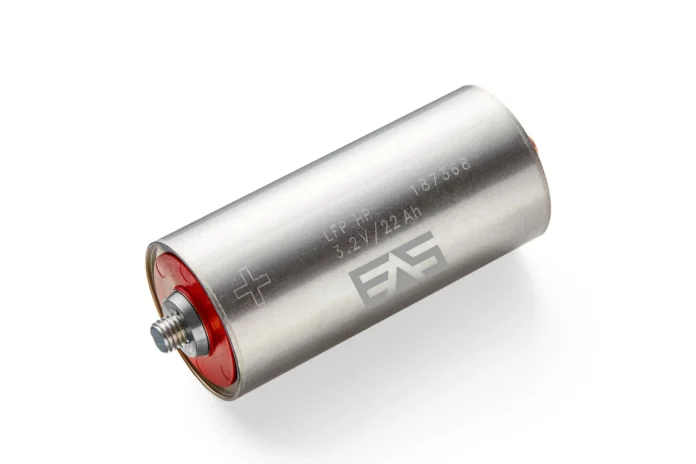
EAS Batteries has begun commercial sales of a new ultra-high-power lithium iron phosphate (LFP) cylindrical cell built around Asahi Kasei’s Acetolyte electrolyte, marking a rapid move from licensing to production and signalling renewed interest in LFP for high-demand applications.
The UHP-601300-LFP-22 — a 22 Ah cell that entered serial production in March 2026 — uses Asahi Kasei’s acetonitrile-containing Acetolyte, which the companies say offers substantially higher ionic conductivity than conventional electrolytes. That increased conductivity reduces internal resistance and improves rate capability across a wide temperature range, enabling the cell to deliver 2,550 W/kg in continuous discharge and 3,760 W/kg in a two‑second pulse. EAS and Asahi Kasei report this represents roughly a 60% increase in continuous specific power versus LFP cells using traditional electrolytes, with a pulse improvement of about 10%.
Beyond power, the cell’s cycle life is competitive: testing at a 5C charge and 5C discharge rate at 100% depth of discharge produced 2,400 cycles while retaining 80% of initial capacity. Samples are already in customer evaluation across several industries, according to the companies.
The commercial launch follows a licensing agreement signed between Asahi Kasei and EAS Batteries in November 2025. Company executives highlighted the speed of development: serial production began only months after the licensing deal, reflecting close collaboration to translate the electrolyte technology into a market-ready cell. EAS managing director Michael Deutmeyer said the rollout and the parallel work on larger formats underscore the strength of the partnership; Osamu Matsuzaki, Asahi Kasei’s senior executive officer responsible for R&D and IP, emphasised the rapid move from agreement to commercialization.
Work is already underway to adapt Acetolyte for larger 46xxx cylindrical cells aimed at low‑voltage electric vehicle battery packs. Prototype 46xxx cells are available for testing and a broader commercial launch is targeted later in 2026. Both firms plan to sublicense the combined cell-and-electrolyte technology to global automakers and battery manufacturers, aligning with Asahi Kasei’s broader licensing-driven strategy to monetize its technology portfolio.
Under its medium-term management plan, Asahi Kasei is pursuing a Technology-value Business Creation approach that emphasizes licensing patents, know-how and related assets. The company has set a target of concluding multiple licensing agreements during fiscal 2025–2027 and aims for cumulative profit from licensing activities of around JP¥10 billion (about US$63 million) by roughly 2030.
EAS Batteries, a specialist in large-format cylindrical LFP cells based in Nordhausen, Germany, positions the new product as part of its long-standing focus on robust, high-performance cells for aviation, automotive, maritime and industrial applications. Asahi Kasei, a diversified Japanese materials group, frames Acetolyte as a way to improve power output at low temperatures, increase durability at high temperatures, reduce pack cost and allow smaller pack designs that raise overall energy density.
Analysts and industry observers will watch uptake among electric-vehicle and high-power industrial customers to see whether the performance advance shifts more applications toward LFP chemistry, long prized for cost and safety but historically seen as weaker in high-power scenarios compared with nickel‑rich cathodes. For EAS and Asahi Kasei, the immediate focus is delivering the new 22 Ah cell at scale and progressing the 46xxx product to market later this year.

