
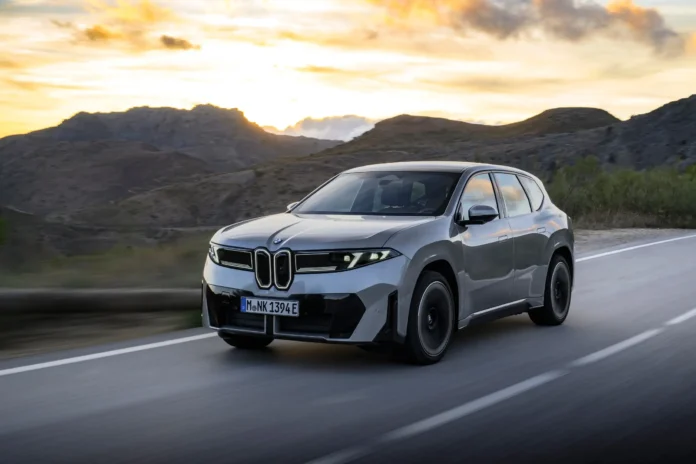
BMW has lifted the curtain on its next-generation electric SUV, positioning the new iX3 as an antidote to common EV complaints—particularly the jerky, uneven feel some drivers associate with electric braking. Unveiled ahead of its domestic rollout in South Korea, the company says the vehicle’s breakthrough is not only in range or charging, but in how smoothly and predictably it controls the car at everyday speeds.
At the heart of the iX3’s claims is a new integrated driving-control system BMW calls “Heart of Joy.” The system is built around four high-performance supercomputers that centrally manage acceleration, braking, and steering, rather than relying on more traditional, distributed electronic control approaches. BMW describes the processing as dramatically faster than before, allowing the vehicle to detect subtle changes in road conditions in extremely small time slices and adjust vehicle behavior accordingly. The goal is a driving experience that feels seamless—less like an EV “switching modes” and more like a conventional car delivering consistent pedal response.
BMW’s most attention-grabbing feature is a stop-focused program it dubs “Joy of Stopping.” During an onboard demonstration, journalists attempted to determine the exact moment the SUV reached a complete halt while unable to rely on sight or sound cues. BMW says participants could not reliably detect when the vehicle stopped, attributing the effect to a “Soft Stop” function that handles the vast majority of daily braking using precise regenerative braking, supported by the system’s refined control strategy rather than relying heavily on friction brakes.
The smoothness is also framed as practical and measurable. On a slalom-style course, BMW demonstrated stable body motion while changing direction quickly, including a scenario where a cup of liquid placed on the roof showed minimal sloshing. The message is that the new control architecture isn’t only about comfort at low speeds, but about maintaining composure through dynamic maneuvers.
Inside, BMW is trying to reduce driver distraction by moving away from the conventional instrument cluster. The new iX3 introduces “BMW Panoramic Vision,” which projects key driving information across the lower section of the windshield, aligning it with the driver’s forward line of sight. BMW also combines this with a central display and associated “Panoramic iDrive” approach, emphasizing that the driver can access speed, navigation, and range without repeatedly shifting attention between separate screens.
On the technology side, the iX3 is presented as a major step in BMW’s software-defined vehicle (SDV) push under the “Neue Klasse” strategy. BMW says the iX3 is the first mass-production model to apply these next-generation technologies, with the vehicle’s software architecture structured to evolve through updates. The company further promotes a “Superbrain” concept: each of the four central computers focuses on different domains, including driving dynamics, driver assistance, infotainment, and core vehicle functions—together providing a foundation BMW expects to support continuous improvement.
Charging and power capability are also central to the pitch. The iX3 uses a 113.4 kWh high-voltage battery and targets a certified driving range of up to 611 km on South Korean standards. BMW highlights an 800V architecture designed for rapid charging, claiming that topping from 10% to 80% can take about 21 minutes and that around 10 minutes can secure roughly 250 km of additional range. It also includes V2L (vehicle-to-load) capability, enabling the SUV to power external devices and enabling use cases beyond driving—effectively turning the vehicle into a mobile power source for electronics and appliances.
BMW’s convenience technology includes an “Intelligent Charging Flap” that automatically opens the charging port when the driver arrives at a charging location recognized through navigation data, and then closes it after charging is complete. BMW contrasts this approach with systems that require manual interaction, framing it as a more seamless experience for EV users as charging networks expand and become better mapped.
Performance figures round out the product narrative: the dual-motor setup is rated at up to 469 horsepower, with peak torque of 65.8 kg·m, and acceleration from 0 to 100 km/h claimed at 4.9 seconds. BMW’s charging and battery architecture emphasize improved energy density and faster charging relative to earlier designs, while also noting that some consumer-preferred features—such as ventilated seats—are not included at launch.

