
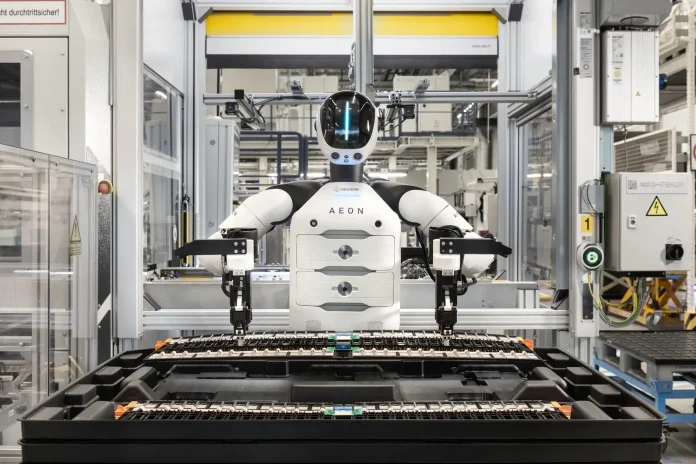
The BMW Group is taking strides in the integration of artificial intelligence (AI) into its production processes, with a new focus on “Physical AI.” This approach blends digital AI with real-world machinery, marking the first introduction of humanoid robots into production lines in Europe at the Leipzig plant. The initiative aims to enhance efficiency and explore new applications in both automotive assembly and battery manufacturing.
Advancements in AI Integration
Milan Nedeljković, a member of BMW AG’s board, emphasized the competitiveness gained through digitalisation, stating that combining engineering expertise with AI creates new opportunities. Last year, a similar pilot project was conducted at BMW’s Spartanburg plant in the United States, yielding valuable insights that have informed the European rollout.
Central to these advancements is a unified IT and data model across BMW’s production systems. This approach breaks down isolated data silos, allowing for consistent, real-time data availability. Consequently, digital AI agents can autonomously tackle complex tasks while continually learning, marking a crucial shift in production methodology.
Michael Nikolaides, Senior Vice President of Production Network at BMW Group, noted the organization’s objective to be a leader in technology integration, particularly in using AI-enabled robotics for practical industrial applications.
Role of Humanoid Robotics
The decision to incorporate humanoid robots into BMW’s automation portfolio stems from their potential to handle monotonous, ergonomic, or safety-sensitive tasks. This technology aims to alleviate the physical burden on employees, improve working conditions, and further advance the automation landscape.
To effectively consolidate expertise in this field, BMW has established a “Center of Competence for Physical AI in Production.” This center serves as a hub for partnerships with technology companies interested in testing and implementing AI-driven robotics in industrial environments.
Pilot Project in Leipzig
The collaboration with Hexagon, a long-standing partner renowned for its sensor technology and software, has led to the initiation of the first pilot project in Europe. Hexagon Robotics introduced its humanoid robot, AEON, in mid-2025, which is designed for multifunctional applications in production.
The pilot project at Leipzig commenced with laboratory tests before moving to an initial deployment phase in December 2025. Full integration testing is scheduled for April 2026, with the aim to start the official pilot phase in the summer.
The AEON robot’s human-like design allows for flexible attachment of various tools, enabling its use in assembling high-voltage batteries and manufacturing components.
Learning from Spartanburg
BMW’s first foray into humanoid robotics at the Spartanburg plant showcased significant achievements. The Figure 02 robot, deployed in 2025, supported the production of over 30,000 BMW X3 vehicles, performing precise and physically demanding tasks, such as positioning sheet metal for welding. With successful operations over 1,250 hours, the pilot emphasized that humanoid robots can perform repetitive, intricate tasks reliably and safely.
Key lessons from this project underscored the importance of integrating production IT infrastructure and fostering early collaboration among various departments. Early communication about the introduction of humanoid robots generated employee interest and acceptance, allowing the technology to become a seamless part of everyday operations.
Future Directions
As BMW evaluates additional potential applications for humanoid robotics in its production processes, Michael Ströbel, Head of Process Management and Digitalisation at BMW Group, expressed enthusiasm for this new endeavor in Germany. The company plans to focus on varied applications across production areas, including battery manufacturing for energy modules and component production for exterior parts.

