
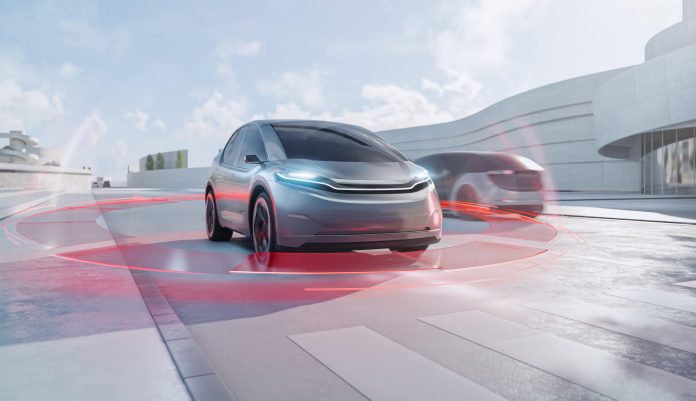
Accurate perception is essential for the safe operation of connected and automated vehicles. However, a single vehicle is limited to its own viewpoint, making it vulnerable to occlusion, restricted sensing range, and detection failures in complex traffic scenes. Collaborative perception—where vehicles share sensing information—can address these shortcomings. Nevertheless, existing approaches often transmit full feature maps or dense sensor data, imposing significant communication overhead that hinders practical deployment.
To address this limitation, researchers from the Department of Automation at Tsinghua University and the Institute of Intelligent Transportation Systems at Zhejiang University developed Which2comm, an efficient collaborative perception framework for connected and automated vehicles. Instead of sharing broad region-level feature maps, the framework transmits compact object-level semantic information, termed Semantic Detection Boxes (SemDBs). These sparse features retain key spatial and semantic details necessary for 3D object detection while greatly reducing the data volume that must be exchanged between vehicles.
A central innovation of the framework is its safety-risk-aware collaboration strategy. Rather than treating all vehicles equally in communication, Which2comm adaptively selects the most informative collaborative agents based on their relevance to driving safety. The framework also incorporates temporal feature fusion and relative time encoding, enabling better handling of communication latency and asynchronous data from different vehicles.
The researchers evaluated Which2comm on multiple collaborative perception datasets, including V2XSet, the real-world V2V4Real dataset, and a newly constructed large-scale dataset named Multi-V2X. Multi-V2X comprises 146,000 LiDAR frames, 549,000 RGB images, and approximately 4.219 million 3D annotation boxes, supporting high-density connected-vehicle scenarios with up to 31 connected agents and a connected-vehicle penetration rate of 86.21%.
Experimental results demonstrate that Which2comm achieves strong detection performance at a very low communication cost. On V2XSet, it attains 0.929 [email protected] and 0.833 [email protected] while requiring only 0.022 MB of transmitted data. The framework also outperforms existing collaborative perception methods on Multi-V2X and V2V4Real, showing robustness under communication latency and scalability in dense connected-vehicle environments.
The study indicates that object-level sparse communication can render collaborative perception more efficient, scalable, and practical for future intelligent transportation systems. By reducing communication redundancy while maintaining high perceptual accuracy, Which2comm offers a promising step toward real-time cooperative perception in connected and automated transportation systems.
Looking forward, the researchers plan to extend the framework to more complex real-world scenarios, such as multi-modal sensor fusion, localization uncertainty, and packet loss, further enhancing the model’s applicability and readiness.

