
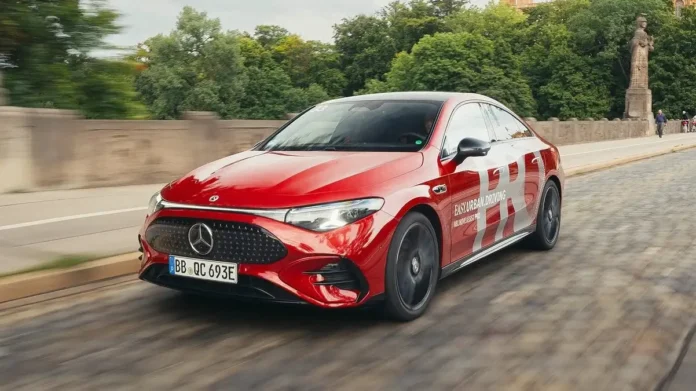
Mercedes-Benz has become the first car manufacturer to receive approval from Germany’s Kraftfahrt-Bundesamt (KBA), the federal motor authority, for a point-to-point driving assistance system. The system, called MB.DRIVE ASSIST PRO, is classified as SAE Level 2. The driver must keep watching the road and remains legally responsible, but the system can follow a navigation route from start to destination, including dense city traffic.
Approval was granted under UN Regulation No. 171, the international standard for Driver Control Assistance Systems (DCAS), which sets safety requirements for advanced driving aids. Mercedes says a harmonised framework under that regulation is expected to take effect in January 2027, which could allow the same software to reach other markets where the rule applies.
How the System Works
With navigation active, the driver presses a button on the steering wheel to engage the system. The car can then change lanes, merge into the correct lane, turn at junctions, and brake and pull away at traffic lights. On motorways, it can also assist when leaving the highway. The vehicle relies on 27 sensors, including ten cameras, five radars and twelve ultrasonic units, which feed an Nvidia computer rated at up to 254 TOPS.
Mercedes describes the aim as reducing driver fatigue in everyday travel. Jörg Burzer, the company’s Chief Technology Officer for development and procurement, said the approval “underlines our ambition to remain at the forefront of automated driving.”
Rollout Plans
An Early Access Programme begins in December 2026 for selected customers in Stuttgart and Munich. The company will use this phase to collect user feedback before a wider launch. Sales across Germany are planned for the first half of 2027, with the system gradually made available across all powertrains in Mercedes-Benz’s passenger car and van range. Existing customers with eligible vehicles will be able to add the functions through an over-the-air software update. German pricing and model details have not yet been announced.
Competitive Context
The approval places Mercedes ahead of rivals in German cities. BMW’s City Assistant, sold as a €1,450 package on the iX3, still only stops at red lights and pulls away on green, with route-following city functions due in 2027. Tesla’s system, now called Tesla Assisted Driving in Europe, had been accepted in ten EU countries through a Dutch approval by early November, but Germany was not among them.
Mercedes has also introduced a separate hands-free motorway assistant, usable at up to 130 km/h, which starts in Germany at the end of 2026. BMW received approval for comparable hands-off motorway driving in autumn 2025, so the two German manufacturers have each taken a lead in different settings: BMW on motorways, Mercedes in towns and cities.
Background
The new system follows Mercedes-Benz‘s earlier Drive Pilot, a Level 3 system that allowed drivers to take their eyes off the road, with the manufacturer responsible while it was engaged. Drive Pilot was approved by the KBA in December 2021, the first such approval in the world, but it was limited to motorways and speeds up to 95 km/h. Mercedes paused it in January 2026. MB.DRIVE ASSIST PRO differs in that responsibility returns to the driver, but the system covers far more of the journey.
Mercedes is developing the system with Nvidia for Western markets and with Momenta in China, where it has been an investor since 2017. The company has also signed a deal with Wayve for an AI driver to be used in a future model. In the United States, early access is planned in California, and pricing has been reported at about €3,600 ($3,950) for three years. The system has been on sale in China since the new CLA arrived.

