
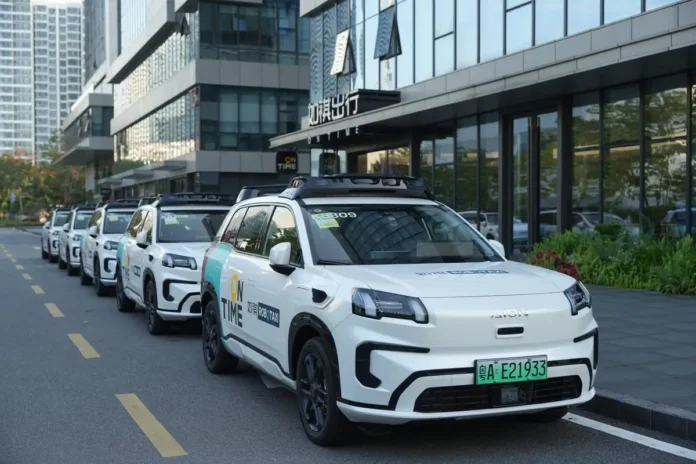
Pony AI and Uber have announced an expanded strategic partnership aimed at deploying more than 2,000 robotaxis across Europe, marking one of the largest autonomous taxi rollout plans in the region.
The agreement, announced on August 14, will build on Pony AI’s existing commercial robotaxi operations in Zagreb, the capital of Croatia. Under the expanded plan, robotaxis are set to operate in a total of five European cities, with additional details to be released in phases. Company representatives also said services in Zagreb will soon be integrated into the Uber app, enabling riders to request Pony AI robotaxis directly through Uber’s platform.
Both companies said the partnership is designed to move beyond early, limited trials and toward scalable, repeatable commercial services. Pony AI will contribute its L4 autonomous driving technology and operational know-how, while Uber will provide the ride-hailing platform reach, including payments, customer support, and broader network capabilities. Local fleet partners are expected to handle daily operations in each city.
The companies framed the expansion as a step toward building sustainable autonomous mobility at scale. Pony AI founder and CEO James Peng said the expanded partnership reflects a shared commitment to bringing safe and reliable robotaxi services to more European cities, combining Pony AI’s technology and operating experience with Uber’s international ride-hailing footprint.
Uber’s global head of autonomous mobility and delivery, Sarfraz Maredia, said the next stage of autonomous mobility involves shifting from single-city pilots to larger operations that can be replicated across multiple markets. He added that combining Pony AI’s autonomous driving capabilities with Uber’s hybrid network and local operational approach is intended to support faster and more reliable deployment.
The rollout comes amid broader competition and rapid progress in autonomous taxi services worldwide. Industry discussions in the autonomous mobility sector have emphasized that larger fleet sizes—often around 1,000 vehicles—can be a turning point for commercialization, allowing more efficient coverage and better dispatching economics. Companies such as Waymo, which operates a fleet of about 5,000 vehicles concentrated largely in the United States, have also been working to expand services internationally, including testing in London.
At the same time, other players from China have been advancing plans to expand into Europe. The announcement from Pony AI and Uber follows earlier efforts by Chinese partners in various markets, including planned pilots and operational partnerships. Both Uber and Pony AI also said they intend to deepen cooperation beyond Europe, including plans for further work in the Middle East.
Financially, Pony AI has previously highlighted cost and economic advantages as part of its expansion strategy. The company has reported reaching per-vehicle economic break-even in multiple Chinese cities and has said its vehicle costs are significantly lower than those of Waymo, supported by its approach to integrating engineering, supply chain, and manufacturing.
Looking ahead, Pony AI said it aims to operate in more than 20 cities globally with a fleet exceeding 3,500 vehicles by 2026. The company is also scheduled to release its latest quarterly results on August 18, which investors and industry observers will likely view as an additional indicator of how the company’s international scaling efforts are progressing.

