
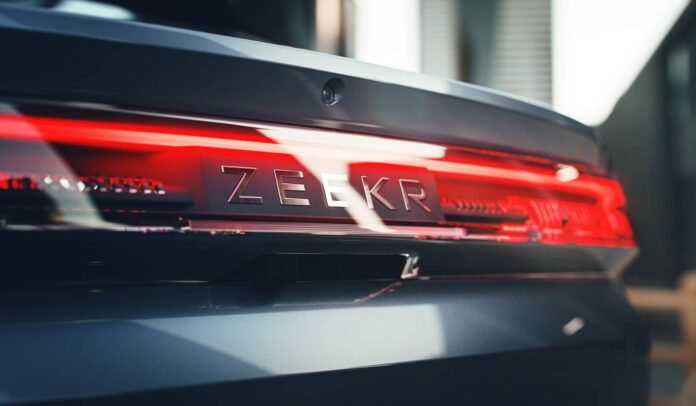
Autonomous driving company quietly imports thousands of Chinese vehicles while tariffs block consumer access to the same technology, revealing cracks in America’s automotive protection strategy.
Waymo, the United States’ largest robotaxi operator, has imported more than 3,200 electric vehicles manufactured by China’s Zeekr since 2024, with over 2,600 arriving in 2026 alone. The imports underscore a fundamental contradiction in U.S. trade policy: Chinese EVs remain legally inaccessible to American consumers through retail channels, yet the country’s most advanced autonomous vehicle company is deploying them commercially on city streets in Los Angeles and San Francisco.
The vehicles—Zeekr CM1e platforms customized into Waymo’s “Ojai” compact electric vans—cost roughly half as much as the Jaguar I-Pace models currently dominating Waymo’s fleet. Industry estimates suggest that even with the 127.5% tariff imposed on Chinese-assembled EVs, the customized Ojai would cost less than half the price of the Jaguar I-Pace. For a company planning to scale operations across multiple cities, the per-unit savings translate into hundreds of millions of dollars.
A Legal Workaround
Waymo navigates U.S. trade restrictions through a strategic division of labor. Zeekr manufactures traditional automotive hardware—body, chassis, battery, and electric drivetrain—in China. Waymo then integrates the autonomous driving hardware and software at its Arizona facility after vehicles arrive in the United States. This arrangement circumvents the Commerce Department’s “Connected Vehicles Final Rule,” which explicitly bans the import of complete vehicles with Chinese-developed autonomous or connectivity software.
The approach buys Waymo time before regulations expand in 2029 to block imports of standalone Chinese components. However, the deeper question remains: why is a leading American technology company forced to source from China?
America’s Manufacturing Gap
The answer points to the absence of competitive new energy vehicle platforms domestically. China’s mature supply chain offers advantages that American legacy automakers cannot yet match: vertically integrated battery production, proven electric drive systems, electronic controls, and thermal management expertise. Zeekr’s modular SEA (Sustainable Experience Architecture) platform enables rapid customization—launching new vehicle variants in 12 to 18 months—a pace that traditional automakers like BMW, Chevrolet, and Hyundai struggle to replicate.
Waymo requires not merely an automaker, but a supply chain agile enough to integrate proprietary autonomous systems. China delivers this capability; American manufacturers do not.
The Protectionism Paradox
Meanwhile, legacy U.S. automakers have squandered the protection window created by tariffs and bans. Ford’s electric vehicle division lost $4.8 billion in 2025, with cumulative losses exceeding $16 billion since 2022. General Motors wrote down $7.6 billion on its EV business; Stellantis posted a 22.3 billion euro net loss in 2025. Combined strategic losses across these three giants surpassed $50 billion—yet they remain less competitive than rivals who faced direct Chinese competition.
Notably, BYD overtook Tesla as the world’s largest seller of fully electric vehicles despite having virtually no access to the American market. The company’s growth stems from global dominance in battery technology, manufacturing scale, and export momentum—advantages a domestic tariff wall cannot diminish.
Europe’s Different Path
Europe opted for a “co-opetition” approach rather than isolation. The EU imported over one million passenger cars from China in 2025, with approximately 650,000 pure EVs, despite raising tariffs on Chinese vehicles. The competitive pressure accelerated electrification at European legacy automakers, forcing them to cut prices and iterate products faster.
America’s strategy—tariff barriers combined with security-based restrictions—has instead provided domestic manufacturers with what one industry executive called a “get-out-of-jail-free card,” removing pressure to innovate while consumer choice remains blocked.

