
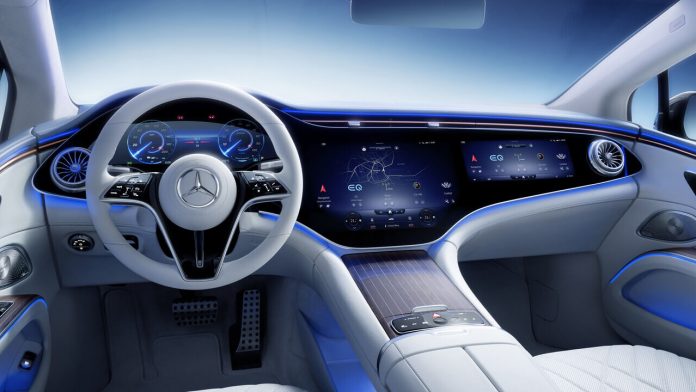
According to Ramin Hasani, CEO of Liquid AI, speaking on Peter Diamandis’s podcast, Mercedes-Benz will begin rolling out a software update in 2026 to North American vehicles from model year 2022 onward that adds a new, on-device artificial intelligence assistant. The company’s plan includes a multimodal AI foundation model—small enough to fit in under one gigabyte—that is designed to run on automotive chips costing about $60 and equipped with roughly 2 to 8 gigabytes of RAM.
The update will be delivered over the air and will enable the assistant to control between 700 and 1,200 vehicle functions. The system is intended to go beyond simple voice commands limited to a fixed set of phrases. Instead, Mercedes describes the model as receiving full access to the car’s operating system and controllable functions.
A key feature described for the assistant is persistent memory. Mercedes said the AI would remember conversations and user preferences across sessions, allowing the assistant to personalize the in-car experience without requiring constant cloud interaction.
Liquid AI, the company providing the technology, says follow-on improvements will be distributed through relatively small software updates—about 20 megabytes—so the system can “recursively” improve personalization over time without downloading a full model again.
In April 2026, the automaker announced it would work with Liquid AI to scale embedded, on-device intelligence for Mercedes models with third- and fourth-generation MBUX systems in North America, aiming for an initial production deployment of advanced speech technology in the second half of 2026.
According to Mercedes executives, the approach is designed to support real-time, local and private AI experiences that do not depend on continuous connectivity. The partnership is described as evolving Mercedes’ existing MBUX virtual assistant by combining voice control with vehicle functionality and contextual understanding, with Liquid AI focusing on efficient “low-footprint” models for on-device operation.
The company said the effort complements existing cloud-based large language model ecosystems by moving more intelligence directly into the vehicle—targeting faster response times and more consistent performance during everyday driving conditions, even when cloud access is limited.

