
Data Flywheel Theory Meets Reality: Hyundai’s Robots Aim to Feed Continuous Learning
Hyundai Motor Group is accelerating its push into “Physical AI” by moving to take full control of Boston Dynamics and by laying out a commercialization roadmap centered on humanoid robots and the data they generate. The steps, taken together, signal an aggressive strategy to transform the automaker and its robotics ecosystem into a vertically integrated platform for both hardware deployment and motion analytics—an approach executives and analysts say could become as valuable as the robots themselves.
In a major corporate development, Hyundai Motor Group has agreed to acquire SoftBank’s remaining 9.65% stake in Boston Dynamics for about $325 million (approximately ₩500 billion). Once completed, the robotics company will become a wholly-owned subsidiary. The transaction was executed as a deadline approached for a put option established during Hyundai’s 2021 acquisition. That put option set the selling price at contractually predetermined levels, and Hyundai moved swiftly after SoftBank indicated its intent to sell the stake.
Hyundai’s ownership position is expected to rise from 90.35% to 100% after the deal closes. As of the end of last year, Boston Dynamics’ shareholder mix included Euisun Chung (22.6%), Hyundai Motor (28%), Kia (17.2%), Hyundai Mobis (11.3%), Hyundai Glovis (11.25%), and SoftBank (9.65%). Hyundai plans to hold extraordinary board meetings across its affiliates starting on the 22nd to finalize internal approvals.
Economically, the deal highlights how dramatically the market’s expectations for Boston Dynamics have evolved. The companies’ calculations indicate that the enterprise value of Boston Dynamics has surged roughly 24-fold over four years since Hyundai’s initial purchase for $1.1 billion (about ₩1.2482 trillion). Industry estimates discussed in the reporting suggest that if Boston Dynamics’ enterprise valuation reached levels implied by recent market thinking, SoftBank’s 9.65% stake could have been worth materially more than the contracted price. However, Hyundai’s acquisition proceeds at the put-option level—meaning the purchase occurs at a level described as below current market estimates. This structure effectively transfers upside from the minority holder to Hyundai while simplifying Boston Dynamics’ governance under a single owner.
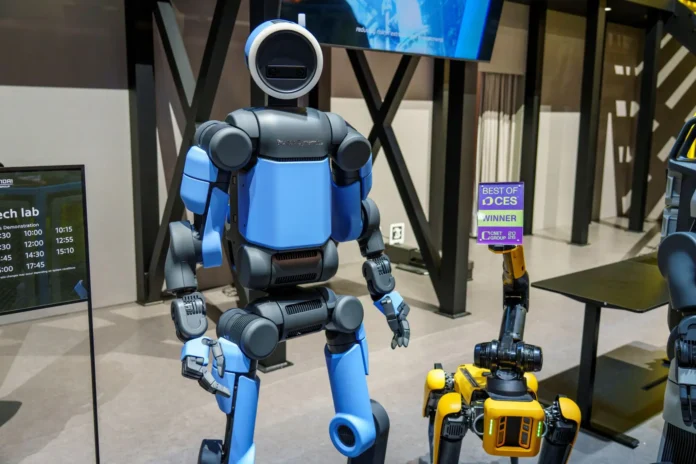
Beyond corporate structure, Hyundai’s plan is centered on scaling humanoid robotics and monetizing motion data. One report states that Hyundai intends to deploy more than 25,000 Atlas humanoid robots across global production facilities. Hyundai Mobis is expected to supply actuators to support mass production targeted for 350,000 units per year by 2028, while Boston Dynamics prepares manufacturing capacity toward around 30,000 humanoids annually under the emerging supply chain arrangement. Hyundai is also reported to be building a forward base in Guangzhou, China to support component procurement.
Crucially, Hyundai’s ambitions extend beyond robotics deployment into a data-centric business model. Hyundai plans to open a Robot Motion Analytics Center (RMAC) at its Georgia plant in the third quarter. RMAC is designed to centralize physical motion telemetry from deployed robots, with Hyundai projecting that the resulting datasets could be sold or licensed to Big Tech and AI developers such as Google and Nvidia. The company’s thesis is that the industrial application of robots—working in real environments—creates proprietary data assets that improve performance and can become a commercial product.
Analysts link this approach to structural drivers: labor shortages and rising labor costs, combined with the operational need for stable productivity gains, make robots a compelling investment. Samsung Asset Management’s Eugene Hwan is cited arguing that advanced humanoid robot development and large-scale deployment systems are concentrated among only a small number of players—primarily Tesla and Hyundai Motor Group—because Hyundai can couple manufacturing execution with rapid iteration and data collection on its own lines.
The broader rationale for Hyundai’s move is increasingly consistent with academic and industry analysis of the “data flywheel” concept in Physical AI. At an AX Strategy Forum, Professor Min Dae-ki of Ewha Womans University emphasized that competitiveness in physical AI may depend less on model performance alone and more on how quickly ecosystems accumulate field data and convert it into learning loops. He described physical AI as a platform connecting hardware, perception/judgment, motion control, simulation, and operating systems, arguing that localization failures—discrepancies between digital models and changing physical environments—must be addressed through continuous real-world data collection. Synthetic data and digital twins can help initially, but performance ultimately hinges on the volume and velocity of operational data.
For Hyundai Motor Group, buying out SoftBank and moving Boston Dynamics into full control appears aligned with that thesis. A unified ownership structure can accelerate decisions on manufacturing scale, rollout timelines, and data infrastructure—elements needed to spin a data flywheel quickly. If Hyundai succeeds in deploying large numbers of Atlas robots while capturing and productizing the motion analytics they generate, the automaker’s transformation could advance from vehicle manufacturing to operating a global Physical AI platform.

