
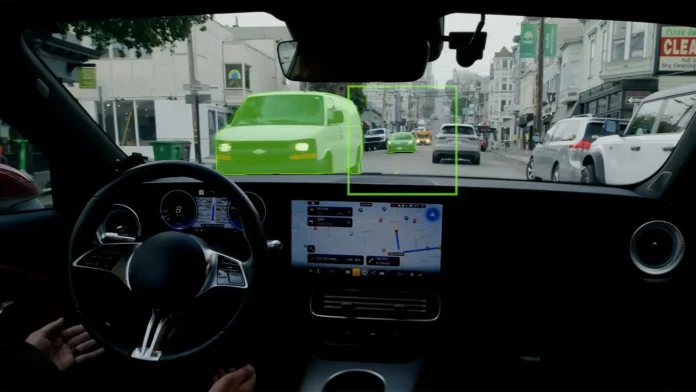
On May 31, NVIDIA unveiled Alpamayo 2 Super, a 32-billion-parameter open “reasoning” foundation model aimed at accelerating level‑4 robotaxi development by shifting autonomous driving systems from trajectory generation toward higher‑level perception, reasoning, planning and action. The release is paired with new simulation and data‑generation tools—AlpaGym and OmniDreams—and an Omniverse Neural Reconstruction pipeline, forming an end‑to‑end stack from fleet data capture to closed‑loop training and in‑vehicle deployment.
Alpamayo 2 Super expands the Alpamayo family from 10 billion to 32 billion parameters and adds full 360‑degree surround perception and Meta‑Action outputs that predict macro driving decisions (for example, yield, lane‑change or stop) in addition to trajectories and chain‑of‑causation (CoC) traces. NVIDIA positions the model as a “teacher” foundation that can produce high‑quality reasoning labels and be distilled into smaller, efficient models that run on vehicle hardware such as the DRIVE Hyperion/DRIVE AGX Thor platforms.
A core claim from NVIDIA is that the model’s reasoning‑based auto‑labeling and 2D grounding will sharply compress data annotation cycles—from months to days—by producing decision‑grounded labels at scale. The company also highlights improved CoC traces and trajectory quality in rare and long‑tail scenarios where conventional imitation‑learning stacks often struggle, arguing that reasoning models provide clearer interpretability for safety validation and regulatory collaboration.
To train and validate these reasoning agents beyond static datasets, NVIDIA introduced AlpaGym, an open‑source closed‑loop reinforcement learning (RL) framework that runs models through continuous decision–observation cycles in simulation rather than evaluating them on recorded data alone. By exposing compounding errors and edge‑case failures that open‑loop training can miss, AlpaGym aims to let models “learn from experience” in simulated driving environments, reducing the risk of encountering unseen failure modes on real roads.
Complementing closed‑loop training, OmniDreams is described as a generative world model that can produce photorealistic, long‑tail driving scenarios at scale. OmniDreams, together with Omniverse NuRec’s Neural Reconstruction tools, converts real‑world fleet footage into adaptable 3D scenes and synthetic training data, reducing repetitive physical data collection and enabling simulation across varied sensor configurations.
NVIDIA emphasized developer productivity with an expanded Agent Toolkit of Physical AI agent skills—prebuilt modules for Neural Reconstruction, OmniDreams scenario generation and AlpaGym closed‑loop workflows—intended to guide developers through simulation, data generation and training pipelines. The company also announced an open‑source CoC Auto‑Labeling Pipeline that automatically generates causally linked decision labels from raw driving clips without human annotation.
Founder and CEO Jensen Huang framed the release as a milestone: “Alpamayo is the moment cars begin to safely reason, not just drive,” he said, stressing NVIDIA’s combination of open models, simulation, real‑world data and agent skills as uniquely positioned to help scale level‑4 robotaxi capabilities.
NVIDIA reports strong early interest in the Alpamayo platform—earlier generations have been downloaded hundreds of thousands of times—and says Alpamayo 2 Super’s inference code and model weights are expected to be made available on GitHub and Hugging Face this summer. The company presents the package—model, closed‑loop training framework and photorealistic scenario generator—as a complete pipeline intended to lower the barrier for AV developers to build, validate and deploy reasoning‑based autonomy at scale.

