
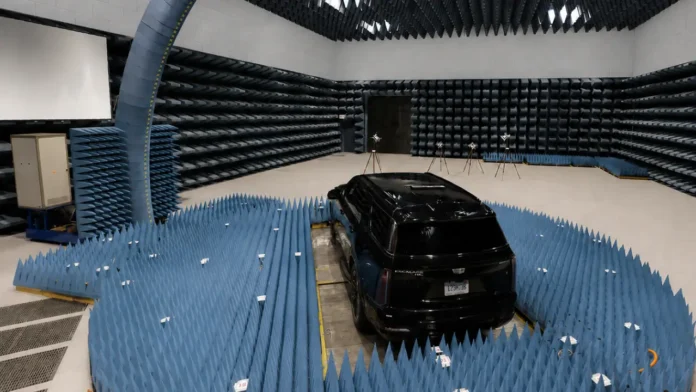
General Motors is replacing its decades-old in-vehicle connectivity architecture with a single roof-mounted Connectivity Hub Module (CHM) that consolidates radios, processors, memory and a backup battery into one integrated unit, the company said. The rooftop CHM will supplant the familiar “shark‑fin” antenna plus cabin‑mounted telematics control unit (TCU) arrangement, eliminating long coaxial runs and delivering the RF performance and digital bandwidth GM says are required for its upcoming software‑defined vehicle platform.
Housed on the roof to maximize radio‑frequency (RF) performance, the CHM combines cellular (including 5G), Wi‑Fi, Bluetooth, Bluetooth Low Energy, Ultra‑Wideband and high‑precision GNSS radios with network processors, memory and an OnStar backup battery into a single edge node. Integrating antennas directly onto the module’s printed circuit board removes metres of coaxial cabling and the dB losses those cables introduce, improving signal‑to‑noise ratio, throughput and connectivity in fringe coverage areas while reducing mass, packaging volume and bill‑of‑materials cost.
The condensed architecture also creates substantial engineering challenges. Packing high‑sensitivity RF front-ends alongside high‑speed digital electronics raises the risk of receiver desensitisation (desense) from internally generated broadband noise. Adjacent radios can interfere with each other (coexistence), and roof mounting exposes the module to intense solar loading while active 5G transceivers generate significant internal heat. GM says it addresses these problems through a combination of multi‑cavity RF shielding, carefully tuned PCB stackups and filtering, acoustic wave filters to sharply isolate bands, time‑domain multiplexing at the software layer to schedule transmissions, and a cast aluminium housing that serves as a structural heat sink.
Those solutions aim to preserve receiver sensitivity and inter‑radio isolation inside a tightly constrained enclosure. Engineers tune drive strengths, spread‑spectrum clocks and localized filtering to suppress harmonic noise, and rely on spatial antenna diversity and orthogonal polarisation to gain isolation. For thermal control, the sealed CHM eschews fans and instead uses advanced thermal interface materials, the aluminium housing, and dynamic software throttling to manage peak thermal events while maintaining safety‑critical communications and battery charge management across extreme ambient temperatures.
Beyond RF and thermal benefits, GM highlights manufacturing and reliability advantages. Removing bulky, vibration‑sensitive coaxial harnesses and fragile RF connectors simplifies assembly, reduces potential failure points, and cuts wiring mass—an important efficiency gain for electric vehicles. Replacing analog cable links with a digital interface such as Automotive Ethernet also lowers installation complexity and labor cost on the assembly line.
GM positions the CHM as foundational to a true software‑defined vehicle, where high‑bandwidth, low‑latency connectivity underpins over‑the‑air updates, remote diagnostics, advanced driver assistance, and data‑rich services. By centralizing radios and compute into a single roof‑mounted node, the company argues it can deliver better RF performance and overall system cost while meeting the data ingestion and latency demands of modern vehicle functions.
The move reflects a broader industry shift away from distributed antenna‑and‑TCU stacks toward compact, integrated edge nodes. GM acknowledges the tradeoffs—especially the multi‑physics challenges of electromagnetics and thermodynamics—but says the CHM’s engineering mitigations enable a lighter, cheaper, more reliable connectivity foundation for next‑generation connected and autonomous vehicle features.

