
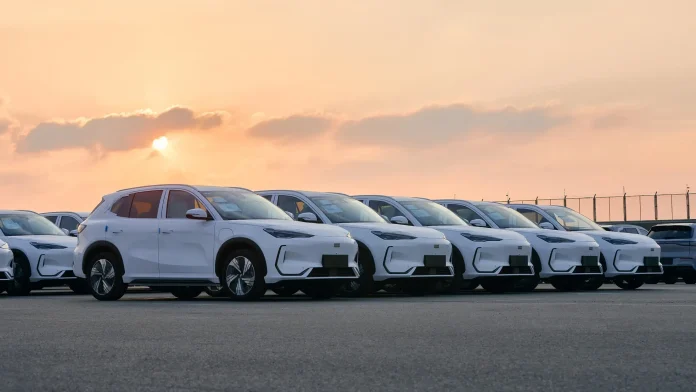
According to the latest research by global market intelligence firm TrendForce, global sales of new energy vehicles (NEVs)—including battery electric vehicles (BEVs), plug-in hybrid electric vehicles (PHEVs), and hydrogen fuel cell vehicles—reached 3.94 million units in 1Q26, marking a 2% YoY decline. NEVs accounted for 19% of global car sales during the quarter. China’s NEV market underperformed, but Western Europe showed signs of recovery, and BEV sales in Japan and South Korea also recorded significant growth.
Reviewing the 1Q26 BEV brand rankings, many Chinese automakers lost market share as their heavy reliance on the domestic market left them exposed to weak local demand, which eroded sales. Against this backdrop, Tesla overtook BYD (referring here to the automotive brand) to regain the top spot in global BEV sales. BYD, Geely, and SAIC-GM-Wuling ranked second to fourth, in order, but all three recorded YoY sales declines. In contrast, fifth-ranked Leapmotor achieved growth by rapidly expanding its product lineup and leveraging a value-for-money strategy. Kia and Toyota also moved up in the rankings, highlighting the risk-mitigating benefits of a diversified global presence.
In the PHEV segment, Chinese brands remained dominant in the first quarter. BYD firmly held the top spot, but its PHEV sales showed a YoY drop, raising concerns about saturation in the domestic market. Intensifying competition at home is prompting major Chinese automakers to shift their strategic focus overseas and to expand their powertrain offerings from pure electric to a broader range of hybrid solutions. Brands such as BYD, Jaecoo (Chery Group), and MG have already recorded notable PHEV sales in overseas markets.
TrendForce estimates that global NEV sales will reach 23.35 million units in 2026, a 14% YoY increase that will continue to outpace the growth of ICE vehicles. However, rising upstream costs are starting to weigh on demand. Upward pricing pressure in the auto market is expected to be stronger this year than in 2025, with the main source shifting from tariff barriers to structural increases in prices of raw materials and components.
As vehicles become more intelligent, the need for massive-scale, high-frequency computing is driving much higher memory requirements. At the same time, memory components have become a major cost burden for automakers due to sharp price increases and a supply-demand imbalance. In China, some domestic brands have already raised prices on models equipped with high-end intelligent driving packages to reflect these higher memory costs. In other regions, automakers face similar cost pressures related to memory costs and geopolitical tensions. These factors are likely to limit room for future discounts and, if they result in broad-based vehicle price hikes, could offset the benefits of NEV incentive programs introduced by governments worldwide.

