
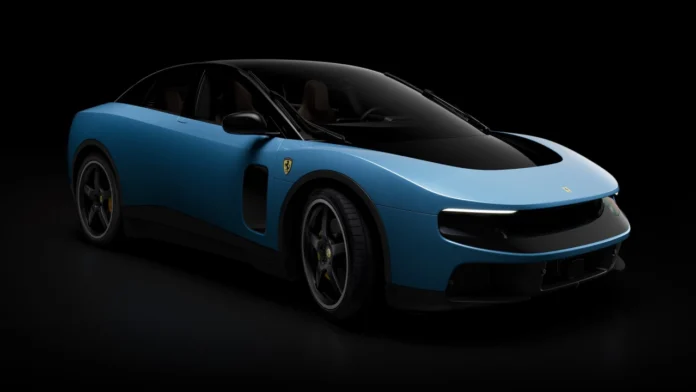
Ferrari has officially entered the battery‑electric era with the Luce, a radically new five‑seat model unveiled in Rome that the company says redefines what a Ferrari can be. Built on a bespoke EV architecture and styled by LoveFrom — the design collective led by Sir Jony Ive and Marc Newson — the Luce pairs an unusually pure “glass house” aesthetic with an aggressively engineered drivetrain and a raft of new technologies developed in Maranello.
Underpinning the Luce is a 122 kWh structural battery pack and four independent electric motors — one at each wheel — that together produce a quoted 1,050 hp and enable extreme torque management. Ferrari reports rear‑axle output equivalent to 831 hp and front axle contribution of 286 hp; the car’s complex control systems include a new Vehicle Control Unit (VCU), an advanced virtual differential, and four‑wheel torque vectoring coordinated 200 times per second. Each wheel also receives dedicated actuators for traction/regeneration, steering angle and vertical movement, giving the Luce exceptional control over motion in every direction.
Performance figures are in the supercar realm: 0–62 mph in 2.5 seconds, 0–124 mph in 6.8 seconds, and a top speed around 192 mph (310+ km/h). Ferrari highlights an 800‑volt electrical architecture and fast‑charging capability that can add roughly 70 kWh in 20 minutes on a 350 kW charger. Range is quoted at about 330 miles (over 530 km by Ferrari’s metric). Despite its substantial battery, the Luce’s kerb weight is 2,260 kg — lighter than some rivals — helped by extensive use of recycled aluminium in body and chassis.
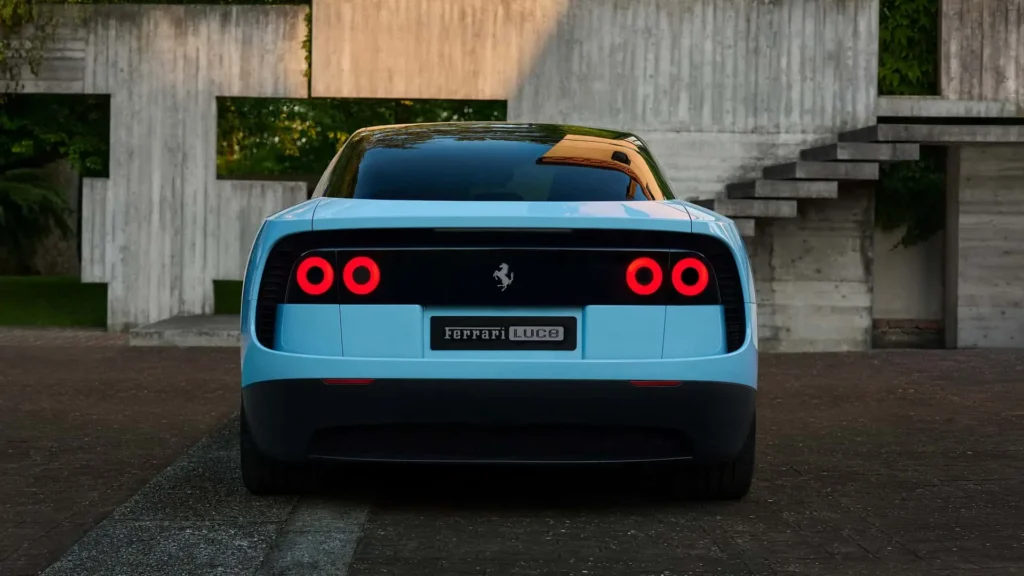
Ferrari has focused heavily on translating EV behaviour into a recognisably Ferrari driving experience. The company developed a “Torque Shift Engagement” system and extended regenerative braking to recreate the progressive torque delivery and engine‑braking feel drivers expect from its cars. An amplified, authentic motor sound is provided rather than a synthetic tone; the Luce’s e‑Manettino and a five‑position Manettino adapt power, traction and recovery strategies to suit grip and driving modes (Range, Tour, Performance). Side Slip Control X, now at its tenth iteration, works with active suspension and independent rear steering to allow dramatic drift angles while maintaining repeatability.
Design and interior mark a clear departure for Maranello. LoveFrom’s direction produced a continuous, shell‑like glass canopy with floating front and rear aerodynamic wings; lighting elements are integrated into primary surfaces to preserve visual purity when off. The Luce features large staggered wheels — 23‑inch front, 24‑inch rear — custom designs, and choices of premium tyres. Inside, tactile mechanical controls sit alongside multifunctional digital displays; materials include recycled anodised aluminium, Corning Gorilla Glass, and extensive leather. Ferrari also specifies a 21‑speaker, 3,000 W audio system with a bespoke “Ferrari Audio Signature.”
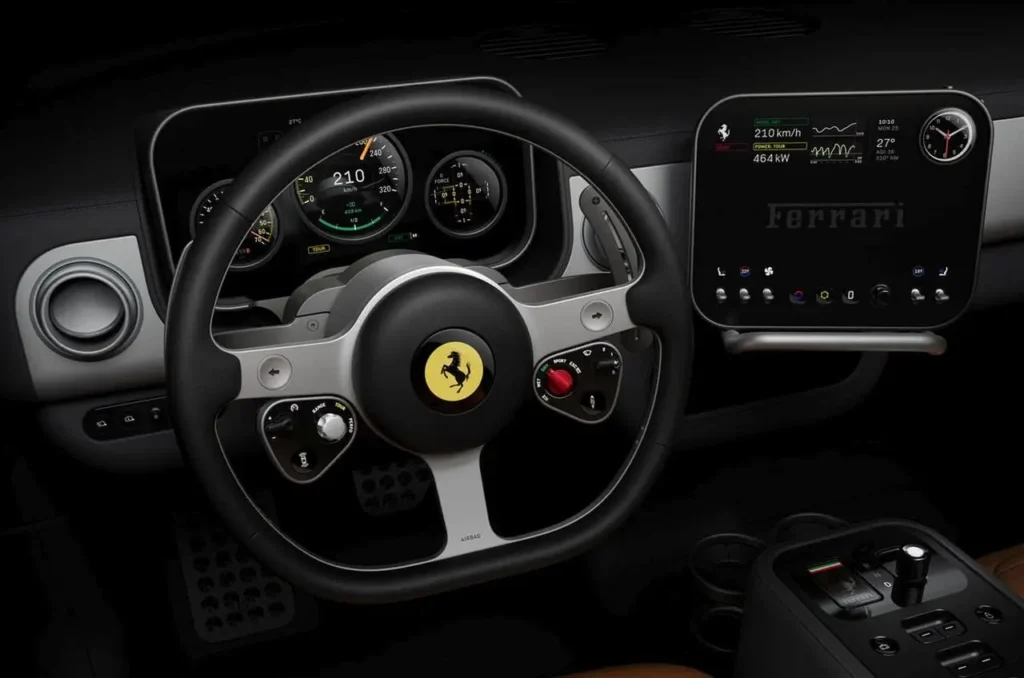
Ferrari emphasises in‑house development: the motors, battery pack and many powertrain elements were engineered and manufactured in Maranello, with the project yielding more than 60 new patents. The company frames the Luce as part of a multi‑energy strategy rather than a replacement of existing combustion offerings, arguing electrification expands design freedom and performance potential across the brand.
Unveiled at the Vela di Calatrava in Rome on May 25, the Luce represents Ferrari’s most radical long‑term departure in its 80‑plus years: a luxury, high‑performance electric five‑seater that aims to retain the marque’s driving engagement while introducing a new visual and technical language for Maranello.

