
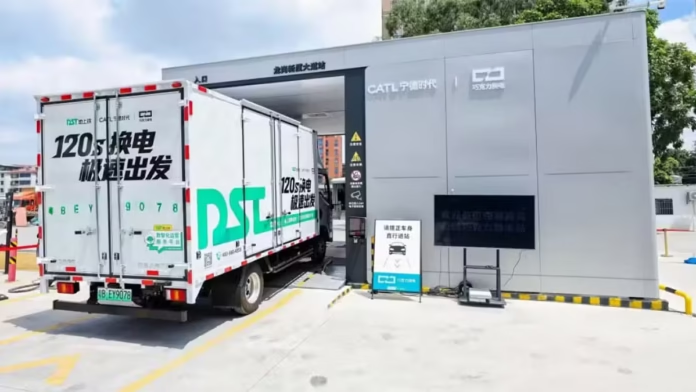
CATL has partnered with logistics operator DST (Digital Sustainable Transport Shenzhen) to officially launch China’s first standardized light truck battery swap ecosystem.
The first batch of standardized battery swap light trucks has been delivered and officially put into urban logistics operation, according to a statement from the Chinese power battery giant on Monday.
This battery swap model, known as Choco-swap, takes only 120 seconds to complete the energy replenishment process.
Over an eight-year vehicle life cycle, the model can save more than 2,000 hours of refueling time, and the energy replenishment cost is only about half that of a fuel-powered light truck, according to CATL.
These modular battery swap stations can serve both passenger vehicles and trucks with wheelbases ranging from 2.7 meters to 3.75 meters.
They are compatible with CATL’s 25# and 35# batteries, achieving battery interoperability between passenger and commercial vehicles, the statement said.
As of now, 31 light truck battery swap stations have been built in the Guangdong-Hong Kong-Macao Greater Bay Area.
By the end of this year, the number of CATL swap stations in the region will increase to 140, prioritizing coverage of high-speed trunk lines and logistics distribution nodes, CATL said.
CATL, its subsidiary Contemporary Amperex Energy Service Technology (CAES), and DST will jointly put 5,000 standardized battery swap light trucks into operation in the Greater Bay Area by the end of 2026.
This will become the country’s largest standardized urban distribution battery swap operation cluster and is planned to be promoted nationwide, CATL noted.
This latest move aligns with CATL’s long-term vision to expand its battery swap business. The company plans to build a cumulative total of more than 3,000 passenger vehicle and light truck swap stations in 2026, with a long-term goal of 30,000 stations.
In the heavy-duty truck sector, CATL reached a trunk logistics electrification partnership with STO Express last month to promote fleet electrification.
Taking the 400-kilometer route from Shanghai to Ningbo as an example, these electric heavy trucks achieved an energy efficiency saving of 0.8 yuan ($0.12) per kilometer compared to traditional fuel vehicles, the company said on April 3.
CATL’s Qiji Energy business plans to build a cumulative total of 900 heavy truck battery swap stations in 2026.
In addition, the company also signed a taxi battery swap network planning agreement with Guangzhou Public Transport Group last month.
This article was first published by Phate Zhang on CnEVPost, a website focusing on new energy vehicle news from China.

