
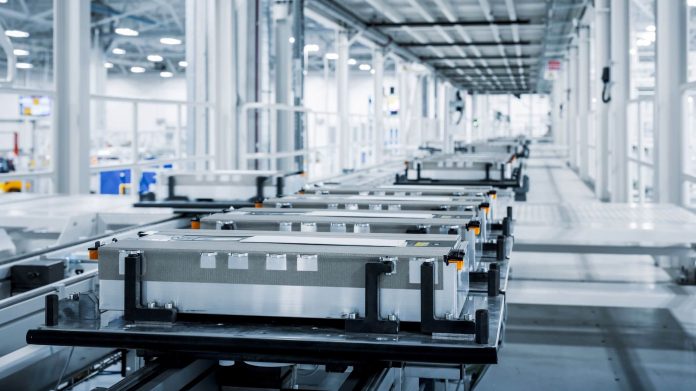
A Princeton study warns that the United States will likely face substantial shortages of critical electric vehicle (EV) battery materials by 2035 unless domestic production expansion, demand-side measures, and international sourcing are strategically aligned. As EV adoption grows in the US and worldwide, demand for batteries and the materials that make them—lithium, nickel, cobalt, graphite and others—is projected to surge, exposing vulnerabilities in the American supply chain that could slow EV deployment and weaken the country’s position in the global transition to electric transport.
The researchers developed a comprehensive modeling framework that traces material needs from projected US EV sales through every stage of the battery supply chain: upstream mining, midstream refining and processing, and downstream component and cell manufacturing. On the supply side the model accounts for existing domestic production, planned capacity and imports, while planned capacity incorporates the development status of projects following the One Big Beautiful Bill Act (OBBBA) of 2025. The study also uses an optimization model to estimate the maximum EV battery production achievable under U.S. sourcing constraints and the likely distribution of battery chemistries, drawing on data about investment, trade and material requirements to allow results to be updated as conditions change.
The analysis finds that while expanding domestic production can meet projected 2035 demand for several key materials—notably upstream lithium and midstream lithium carbonate and hydroxide, as well as some downstream components such as electrolytes and separators—substantial shortfalls remain across other crucial inputs. The models project 30–70% shortfalls for upstream cobalt, nickel and graphite and their midstream refined forms, and 15–75% shortfalls for downstream cathode and anode active materials.
A large share of projected domestic supply relies on early-stage mining and processing projects: for some materials roughly 30–100% of forecasted supply is tied to projects that may face delays or fail to materialize, injecting significant uncertainty into future availability. The study emphasizes that domestic expansion is particularly uncertain in upstream and midstream stages, where projects are capital-intensive and require long development timelines, and that this uncertainty is one reason domestic efforts alone may not close material gaps.
Demand-side strategies—improving vehicle efficiency and battery energy density, boosting recycling and end-of-life collection, and shifting battery chemistries—can narrow some supply shortfalls, but they also involve trade-offs and do not eliminate all constraints. For example, shifting to lithium iron phosphate (LFP) chemistries reduces reliance on cobalt, manganese and nickel but introduces new supply pressures related to LFP-specific components. The researchers also note that their estimates may understate risks if EV adoption accelerates beyond modeled scenarios or if average vehicle sizes increase, since higher adoption and larger vehicles would intensify material demand and deepen shortfalls.
From a policy perspective the study argues for a coordinated approach that combines domestic capacity expansion across upstream, midstream and downstream stages, demand-reducing and shifting measures, and continued international sourcing to fill remaining gaps. The authors caution that narrow policy responses—such as focusing only on domestic content rules, tax credits or tariffs—will be insufficient and may even conflict with efforts to secure essential imports. Because much of the projected future supply has yet to be realized, the researchers recommend streamlining environmentally responsible permitting, providing financial and technical support for viable projects, and offering clear long-term policy signals to increase investor confidence and accelerate project development and ramp-up.
The researchers further call for stronger support for advanced recycling technologies and coordinated planning to manage chemistry shifts so that easing pressure on one set of materials does not simply transfer scarcity to another. Without such alignment—paired with trade and industrial policies that preserve access to international supplies—the United States risks supply shocks that could slow EV deployment, constrain consumer choice and undermine the country’s competitiveness in the global shift to electric vehicles.

