
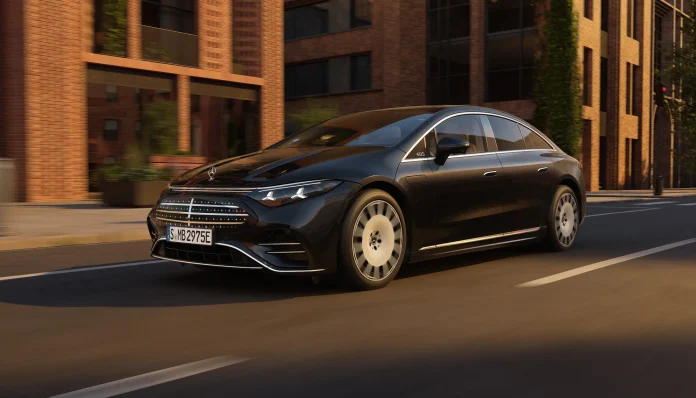
Mercedes-Benz has unveiled a significantly upgraded EQS saloon that pushes electric range, charging speed and in-car software while introducing steer‑by‑wire to German series production.
The headline figure is WLTP range: the EQS 450+ now achieves up to 926 km, about 13% more than the outgoing model. That leap reflects a comprehensive rethink of the car’s electric architecture: Mercedes has migrated key components in-house, adopted an 800‑volt system, fitted new, more efficient electric drive units with a two‑speed gearbox on the rear axle, and enlarged the battery to a 122 kWh pack that uses silicon‑oxide‑enhanced anodes. The battery offers roughly 3% more usable energy in the same installation space and reduces cobalt content, the company says.
Faster charging is a major practical benefit. The 800‑volt setup supports up to 350 kW DC charging, which Mercedes claims can add about 320 km of WLTP range in ten minutes. Where only 400‑volt chargers are available, an intelligent control splits the battery virtually to allow charging at up to 175 kW. Recuperation—how much energy the car recovers when slowing—has also been boosted to a peak of 385 kW, roughly a third higher than before, enabling much stronger regenerative braking.
Mercedes is also bringing steer‑by‑wire to a production model in Germany for the first time. The system, available shortly after launch, removes the mechanical connection between wheel and road, delivering a new steering feel Mercedes says improves manoeuvrability, eliminates unwelcome steering vibrations and allows a flatter wheel that opens up cabin space. The driving architecture also increases towing capability: rear‑wheel‑drive variants can now pull up to 1,600 kg.
On the software side the EQS receives what Mercedes describes as a “supercomputer” under the Mercedes‑Benz Operating System (MB.OS). MB.OS unifies vehicle functions, runs continuously updated software via over‑the‑air updates, and feeds the next‑generation MBUX infotainment, which integrates AI from Microsoft to enable multi‑part dialogues and avatar‑driven interaction. New convenience features include enhanced MB.DRIVE PARKING ASSIST with diagonal parking and faster autonomous parking at up to 5 km/h, portable MBUX remotes for rear passengers, and a HEPA cabin filter. The car also offers bidirectional charging (vehicle‑to‑grid and vehicle‑to‑home) via an OTA update after launch.
Mercedes will broaden the EQS line with an entry variant, the EQS 400, offering 270 kW and a 112 kWh battery to lower the entry price. German pricing starts at €94,403 including VAT for the EQS 400 (or €79,330 excluding VAT for business customers).
Exterior and comfort refinements continue Mercedes’ focus on aerodynamics and luxury: the EQS retains a low drag coefficient (around 0.20), a larger, more efficient DIGITAL LIGHT array and new interior trim and heated seatbelt options designed to heighten the “Welcome home” ambience. Mercedes emphasises that over a quarter of components are new or revised for this generation, positioning the refreshed EQS as both a technical showcase and a more usable long‑distance EV for luxury buyers.

